

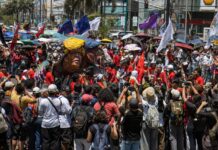
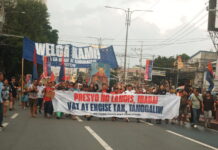
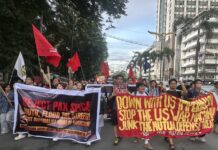
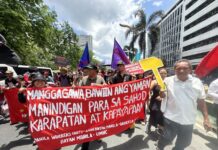






It has been more than four years since Romina Astudillo, Mark Ryan Cruz, Jaymie Gregorio, and Joel Demate, four of the Human Rights Day 7 arrested in a simultaneous raid operation on December 10, 2020. They were dragged from their homes, forced to look away as pieces of evidence were planted, shown the warrant only after, and eventually thrown behind bars.
Take note, it was International Human Rights Day. A day meant to honor freedom. Ironically, they were denied theirs. That while the world marked the struggle to uphold our fundamental rights and freedom, the state weaponized the law only to trample on them.
The remaining four were arrested upon the issuance of search warrants by then Quezon City executive judge Cecilyn Burgos-Villavert. Between 2018 and 2020, Villavert-issued warrants were repeatedly used in crackdowns against activists across Metro Manila, Bacolod, and Southern Tagalog, authorizing the police to forcibly enter the homes and legal offices. What followed was the usual pattern of discovering firearms and explosives absurdly found under a pillow, or stashed in an everyday bag, or just sprawled out in plain sight on a bed alongside several things the activists said they never even owned. If such a setup weren’t so cruel, it would almost be comical.
Two of the HRD7 were Manila Today editor Lady Ann Salem and labor organizer Rodrigo Esparago. Both had their cases dismissed by the Mandaluyong Regional Trial Court (RTC) three months after the arrest. The court ruled that the Villavert-issued warrant was void and vague, noting that the police had seized items beyond those specified and described the raid as a “fishing expedition”. The Court of Appeals (CA) upheld the decision in 2022.
What made the dismissal even more compelling was that the same single search warrant and police narrative were used against all seven. Following the same raid operation backed by the same set of testimonies and the same warrant scheme, the remaining four continue to languish in jail for more than four years without a conviction.
It should be emphasized that the Villavert-issued warrants played a significant role as blueprints of lawfare. Since the collapse of peace talks in 2017 between the Philippine government (GRP) and the National Democratic Front of the Philippines (NDFP), the former Duterte administration rounded up its counterinsurgency efforts through red-tagging and waging war not only in the countryside but also in union offices, community spaces, and even the homes of activists. In 2019, 57 activists were arrested in Bacolod. The following year came the arrest of HRD7. Not long after Salem and Esparago were freed in 2021, nine were killed in Southern Tagalog during the Bloody Sunday raids. In all these cases, one name appears on the search warrants: Villavert.
The Supreme Court seemingly appeared to recognize these issues and mandated the use of body-worn cameras in search and arrest warrant pursuits. In 2024, the court also ruled that red-tagging constitutes a threat to a person’s right to life, liberty, or security. However, all these came too late for the HRD7 and the rest of the political prisoners. And up until now, the Court has not gone further. No genuine investigations were made to look into the already visible pattern in the warrants being used for political persecution. Not even a word with the continued jailing of four individuals who have been red-tagged even before and after they spent nearly 1,400 days behind bars for crimes that were clearly fabricated.
We cannot pretend that this is about the rules of evidence alone, especially when the majority of the Villavert-issued warrants have already been nullified by the appellate and higher courts. This further posed serious questions not only about judicial discretion, but rather on the glaring inconsistency in how the doctrine of independence and constitutional safeguards are applied in a system that selectively applies justice at the expense of the persecuted.
That the Supreme Court has said nothing thus far is itself a verdict that is tantamount to complicity. Lest we forget that twelve of the current fifteen magistrates were appointed under the former Duterte administration, an administration that pioneered the harrowing threat of red-tagging, bloodbath killings, and the weaponization of judicial processes. As a matter of fact, it was the Supreme Court that dismissed the impeachment complaint against Vice President Sara Duterte on purely technical grounds.
But we are not blind to the pattern, nor deaf to the pleas and demands of the aggrieved. It is, afterall, the dirty theatrics of politics and bureaucracy. And justice for political prisoners, however, takes years if it comes at all.
Every day that Astudillo, Cruz, Gregorio, and Demate remain detained without conviction is a day we allow our laws to be used as cages. The Philippine justice system today does not need to prove guilt, as it only needs to accuse. And once accused, activists can be made to rot in jail while those responsible can drag their feet and wash their hands.
We must demand the immediate and unconditional dismissal of charges against the remaining HRD7 and all political prisoners. We also call for the Supreme Court to conduct a full judicial review of all Villavert warrants and take a public and categorical stand against the continued legal persecution of human rights defenders and political organizers.
The Supreme Court should guarantee equal protection under the law. Failure to do so is a betrayal of its moral authority. And if it continues to serve the architecture of repression, then it too must be held accountable.
It is at this critical juncture that Astudillo, Cruz, Gregorio, and Demate are caught in a slow-paced machinery of the current justice system that has failed to protect them. And if justice does not begin here, then what kind of justice is left for the rest of us?


