







March 3, the total lunar eclipse stretches across the sky, painting it in copper and rust.
Tonight, we witnessed the blood moon. But we could not unsee the bombings and the bloodbath beneath the same sky.
It is easy to look at the sky and feel small in a comforting way. To believe that what happens above us is distant and harmless. But somewhere else tonight, when people look up, they do not see an eclipse. They see aircraft. They see fire. They see what falls.
Case in point: in Gaza, in Lebanon, in Iran, in places where bombs fall without warning. There is no sky to look at but only dust and rubble. For them, the red glow of the moon is indistinguishable from the flash of blood and destruction.
With the recent bombings in Iran, a school was struck in the latest wave of attacks led by the United States and Israel’s military operations. Many of the dead were children. Girls. Not to mention, among the casualties of this escalation was an overseas Filipina worker (OFW) Mary Ann Velasquez de Vera.
Here in the Philippines, some of us will look up tonight and see wonder. Some will see a spectacle. We like to believe that these events are far from us—that they belong to another map.
These structures of violence are not abstract. They have names. They have maps. In fact, the United States maintains roughly 750 military bases and access sites across more than 80 countries and territories, including the Philippines. All in the name of projecting global power and enforcing hegemony.
The recent US-Israeli attacks on Iran show how that functions.
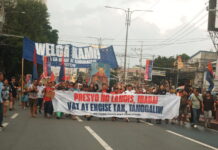
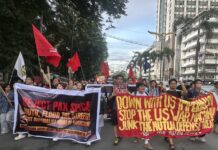
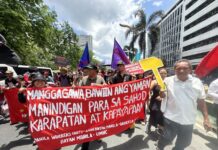
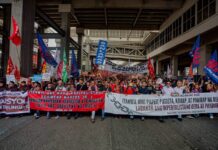
There are nine Enhanced Defense Cooperation Agreement (EDCA) sites across our islands. The annual Balikatan exercises are conducted under the Visiting Forces Agreement (VFA) within the broader framework of the Mutual Defense Treaty (MDT).
And now we are told not to worry, saying there is “no credible threat” to the Philippines from the US-Israeli attacks on Iran.
But with such agreements normalizing the presence of foreign troops, the prepositioning of equipment, and the annual joint military drills tether the Philippines to that same logic. They put us on the map not for our own safety. Instead, they situate us for wars that are not even ours.
And when those wars erupt, women are at the forefront bearing the brunt. Not to mention that six in every ten OFWs are women.
Lest we forget, it is Women’s Month—a glaring reminder that women carry families through displacement. Mothers bury their very own children. And girls lose classrooms; worse, their very lives. Even caregivers like Mary Ann lose their lives in conflicts they did not choose. If we are to honor women, then our response cannot be merely passive mourning.
Tonight, as we look at the blood moon, let us also look around us. At the agreements that allow foreign powers to operate and dominate. At the exercises that force us to accept militarism as normal. We must look at our politics and our land in critique. Because the moon will return. The eclipse will pass. But the very structures of power that allow the foreign war machine to define our security are still here. They are visible if we look closely. They are actionable if we dare to demand it.


