










On July 25, the Supreme Court ruled the impeachment of Vice President Sara Duterte ‘unconstitutional’. Such a decision is widely denounced by legal experts and progressive groups as a blow to public accountability and democratic checks and balances.
The unanimous ruling nullifies the Articles of Impeachment transmitted to the Senate in February 2025, citing a supposed violation of the Constitution’s “one-year rule”. The said provision barred multiple impeachment proceedings against the VP Duterte within a year. Meanwhile, in this case, only one complaint had been officially initiated by the House of Representatives.
Critics stressed that the Court’s ruling has given the premise to VP Duterte to evade trial despite serious allegations of fund misuse and abuse of power.
A misreading of the law
In a statement from the National Union of Peoples’ Lawyers (NUPL), the legal union warned the Supreme Court had “departed from the Constitution” upon twisting the impeachment timeline and creating new requirements not found in the Charter.
There have been four impeachment complaints filed against Duterte since last year: three were lodged in December 2024 but never referred to the House Committee on Justice; meanwhile, only the fourth was signed by more than one-third of House members and was transmitted to the Senate on February 5 this year.
The high court affirmed that the earlier complaints had already triggered the said “one-year bar,” which the legal experts said must have been treated as if they were formally initiated and then dismissed.
NUPL further argued this interpretation contradicts according to the Philippine Constitution, citing the landmark Francisco v. House of Representatives (2003) case which held that only complaints that are both filed and referred to the Justice Committee count as officially initiated.
“To treat unacted, unreferred complaints as having been ‘initiated and dismissed’ is to grant legal effect to what the Constitution does not recognize,” NUPL stated. “In effect, the Supreme Court has conjured a bar from proceedings that never began.”
Bureaucratic, dirty politics
Makabayan bloc in Congress, authors of the original impeachment resolution, said the SC ruling fits into a broader pattern of political bureaucracy maneuvering to protect Duterte from accountability.
At the core of the impeachment complaint is the alleged misuse of P612.5 million in confidential and intelligence funds (CIF) by Duterte’s offices, both as Vice President and then concurrent Secretary of Education, from 2022 to 2023.
Records revealed that a bulk of the 2022 CIF was disbursed in just 11 days, despite questions about legality and necessity. The Commission on Audit issued notices questioning the spending, while the House conducted investigations demanding Duterte’s explanation. Duterte, however, claimed she was barred from discussing CIFs. Such a claim that has been refuted by many critics and legal experts.
Protests have already since mounted even before the SC ruling to demand Senate proceed with the trial.
“Nagbigay ang desisyong ito ng ligal na basbas sa matagal nang pinagsisikapan ng Malacañang at Senado, na pawang humahanap ng paraan para hindi matuloy ang impeachment trial mula pa noong Pebrero,” said ACT Teachers Partylist representative Antonio Tinio, describing the Court’s decision as a major blow in the fight against corruption.
Kabataan Partylist representative Atty Renee Co further stressed that the ruling is an unacceptable ‘new normal’, borrowing the term from President Ferdinand “Bongbong” Marcos Jr.’s own remark that extreme weather has now become the country’s “new normal.”
“Binaha na nga ang kabataan, binuhusan pa ng malamig na tubig ang galit natin laban sa katiwalian ni Sara Duterte. Hindi katanggap-tanggap itong new normal: kontsabahan at walang pananagutan, kinukurakot na pondo na dapat sana para sa edukasyon natin, at tuloy-tuloy na pagsira ng kalikasan at kinabukasan natin,” said Atty. Co.
On June 3, the Senate convened as an impeachment court after receiving the Articles of Impeachment against Duterte transmitted by the lower house. Days after, on June 30, the Senate voted to send the complaint back to the lower house over constitutional technicalities, delaying the trial’s continuation until a Congress willing to pursue it was seated.
Makabayan National Capital Region said that the SC ruling, while presented as procedural, has only strengthened Duterte’s position for her potential 2028 presidential bid.
“It clears the path for her potential run in the 2028 presidential bid, especially since President Marcos is term-limited. It must be noted that 12 of the 15 justices sitting on the high court were appointed during the Duterte administration,” said Makabayan NCR.
The group added that the decision sends a chilling effect, especially for future impeachment efforts, that even constitutionally valid complaints can be nullified by shifting interpretations and internal power plays.
NUPL, meanwhile, emphasized that judicial interpretation should not replace the people’s sovereign right to demand accountability.
“Judicial review must remain vigilant, but restrained; interpretive authority must not evolve into administrative oversight over a co-equal branch. The delicate balance of powers must be carefully maintained. Any departure from this equilibrium, however well-intentioned, risks disrupting the constitutional order,” said the union.
“We reiterate, with due respect to the Honorable Court: constitutional powers must be preserved, especially in the service of accountability. When these powers are subordinated to procedural interpretations that strain the Constitution’s plain meaning, it is not merely institutional balance that suffers—it is the public’s right to demand responsibility from those who wield power in their name. The people will remember what was lost in the process: a clear invocation of the people’s right to hold even the highest officials to account,” NUPL concluded.
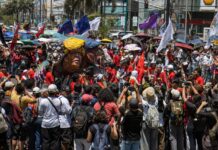
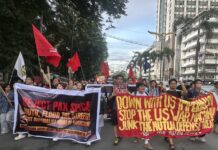
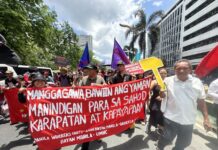
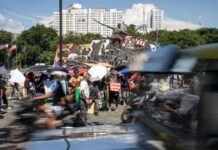
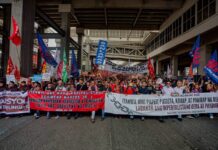
On July 25, various progressive groups held a protest action in front of the Commission on Human Rights to denounce the SC ruling, vowing to continue organizing and mobilizing to fight for truth and accountability.
“Verdict doesn’t end in the courtroom,” said Kabataan Partylist National Capital Region. “It continues wherever the people demand justice.”


