

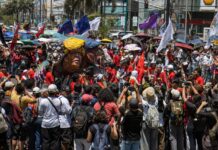
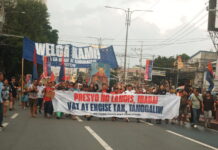
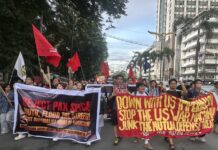
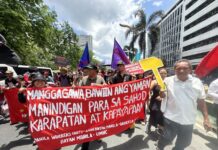



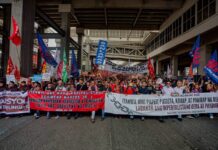


“Ang ating pagkilos ay isang malaking kultural na aktibidad,” said Alwen Jay Santos of Bagong Alyansang Makabayan National Capital Region, “Kaalinsabay ito sa paggunita ng October Revolution at pagkilala rin sa natatanging kabuluhan ng Great Proletarian Cultural Revolution sa Tsina.”

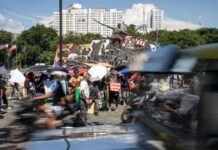
At Liwasang Bonifacio, chants echoed, drums rolled, and flags unfurled as performers moved to Ben&Ben, Zild, and Juan Karlos’ Lunod, portraying the struggle of Filipinos enduring the rampant corruption and political circus.
The Lakbayan ng Mamamayan Laban sa Korapsyon, led by United People Against Corruption (UPAC) and BAYAN NCR, unfolded not just as a symbolic political movement but also as a cultural production that performed the reality of Filipinos in these difficult times.
Street theater

The Lakbayan took form through Dulaang Kalye, which was participated in by various multisectoral formations and sectors of workers, students, women, and urban poor in Metro Manila.
Each group from Sining Bugkos to Alyansa ng Kabataan Laban sa Korapyon (AKSYON), Sulong Manilenyo Korapsyon Labanan (SUMIKLAB), RAGE for Systemic Change, Aksyon Taguig Against Korapsyon, Kyusi for Truth and Accountability, and People Act Now performed skits that exposed the social anatomy of corruption that seeps into people’s everyday lives, particularly with joblessness, academic repression, demolition, and urban militarization, among others.
Ito ang ating panata…
Of the many street plays performed, “Babad na Babad sa Pakikibaka” and “Lakbayan ng Mamamayan” offered a poignant depiction of the lived realities of marginalized communities: from parents grappling with destroyed homes and unpaid rent, to students struggling with hybrid learning, to communities confronting environmental and political injustice brought about the flood control corruption, all while resisting trapo politicians disguised as providers of doleouts or ayuda with empty promises have ultimately blurred the lines between acting and collective struggle.

In Lakbayan ng Mamamayan, the storyline between two ordinary citizens and political elites was established through the interactions of two families: the Castillos and the Velascos. The Castillos navigate daily hardships from flooding and destroyed livelihoods to bureaucratic neglect, and the Velascos represent a political dynasty that enjoys the safety of their luxury condominiums while exploiting the very struggles of marginalized sectors.
“Honestly, they are the least of my problems. Bigyan mo lang sila ng 10k jan, aalis yan! O’ di kaya ipatapon mo sa Etivac. Kapag nagmatigas pa rin, eh ang dami-dami nating mga ‘tropa’ diyan, naghihintay lang sila ng command.”
Sofie Velasco, mother and political adviser of mayor Andie.
“Naiintindihan ko po, Mrs. Castillo… Hindi po namin kayo aalisan ng tirahan, pinag-aaralan pa po namin ang sitwasyon.”
Mayor Andie Velasco
The gap between rhetoric and reality became most palpable in many striking scenes. One including the Velascos’ transactional approach using manipulative authority to underpin every supposedly “benevolent” action, especially when Mayor Andie affirmed polished assurances to vulnerable families like the Castillos as demolition threats loomed.
Another scene also captured the Castillos struggling to salvage their belongings from flooding in a free housing located adjacent to the reclaimed area of Gilcu Compound, where they once lived and was being converted into Lazorivea Waterfront City, owned by the Velascos.
Such acts reflect an all-too-familiar reality for many urban poor communities, especially the performative charity gesture illustrated in various scenes of Babad na Babad sa Pakikibaka.

“Magandang araw po sa mga kababayan! May dala kaming ayuda. May mga pantawid gutom ho rito tsaka kaunting tulong pinansyal!”
Government official
In Babad na Babad sa Pakikibaka, the narrative of community resistance was showcased in the most vivid and arresting scenes as residents lambasted the persistent flooding while government officials attempted to assert authority through gestures of doleouts.
“Oo nga anak, eh. Tulong daw, pero tingnan mo nga, bakit may dala-dala silang baril? Eh kung tunay na tulong iyan, dapat malasakit pinapakita, hindi takot.”
Nanay Myrna

And who else could also portray the very roles of a doting mother and a hardworking father but the residents themselves of Tondo, as one of the most affected by the very conditions depicted onstage, particularly with the emotional and material toll of repeated disasters and systemic neglect compounded by measly wages and mounting debts.


“Kasabay ng paglubog ng bahay natin sa baha ay paglubog din natin sa utang Delfin. Paano natin mababayaran yan, mababa pa sa mababa ang sahod mo.”
Nanay Myrna
“Tayong mga ordinaryo, wala na naman tayong magagawa kung hindi gawing araw ang gabi makaahon lang sa parehong utang at bahang ito.”
Tatay Delfin
But while these were established, there also came a scene where a collective voice hounded these hardships, one that the audience itself also participated in.
These voices came from youth in the community, embodied by Kes, Jenny, Lori, Ruben, and Kleah, who stressed their frustration over structural corruption, linking their toll to systemic corruption and state neglect.


“Hindi ito new normal! Mag-adapt na lang daw tayo sabi ni Marcos. Ulol! Kung pwede lang siya ang anurin sa baha, sana talaga!”
Ruben
“Oo, walang pinagkaiba yang dalawa na yan! Sama mo pa ung mga kurakot na LGU. Sama mo pa si Isko! Puro demolisyon at pagpapalayas sa vendors ang alam.”
Jenny
“Hindi namin kailangan yan! Puro kayo ayuda, puro kayo pera! Ang kailangan namin solusyon sa baha! At ang solusyon sa baha, ay mawala kayong mga kurakot!”
Lori
As the final chant rose, “Ngayon na! Ngayon na! Baguhin natin ang sistema!” the casts and crowd moved as one. And in that moment, the Lakbayan became a movement, tuning into the song of Panata sa Bayan while assembling in their ranks as they prepared for their three-kilometer march to reach the gates of Mendiola.

Burukrata kapitalismo, ibagsak!
Evidently, Lakbayan was an agitprop theater. A political agitation but with a distinctly Filipino cadence and humor, as the audience did not merely watch but also responded and moved in every step of the cultural production.
To further understand Lakbayan’s creative spirit, one must look at how protest culture in the Philippines has long merged performance with politics.

Since the First Quarter Storm to the recent mobilization protests, activists have taken to the streets to confront social ills by connecting popular culture and contemporary art through creative placards, effigies, coordinated attire, and rhythmic chants.
But the Lakbayan’s timing and framing were also deliberate, being held in time for the Great October Socialist Revolution. The protest revisited the revolution’s legacy following its success in strengthening political education and enlightenment as foundations for a just and humane society. For Lenin, the political revolution had to precede the cultural one. As for the Lakbayan activists, culture remains essential to sustain the revolution’s spirit.
The GPCR, on the other hand, showed how culture could serve as a terrain of class struggle. Mao Zedong emphasized the need for a cultural movement rooted in mass participation, propaganda, and the reeducation of youth among various sectors. His call to “bombard the headquarters” further resonated in how Lakbayan protesters confront corruption and bureaucrat-capitalism through cultural performance and mass mobilizations.

“Mga kasama, magpapatuloy pa ang pagbaha ng malalaking protesta sa lansangan. Magpapatuloy ang ating paniningil ng hustisya sa mga burukata-kapitalistang nariyan sa loob ng palasyo. Patuloy nating isusulong ang pambansang demokratikong pakikibaka ng mamamayang Pilipino. Patuloy nating itulak ang mamamayan na lumaban para sa kanilang mga batayang karapatan at kalayaan,” Santos said in his speech.
The Lakbayan’s culture-centered approach carries forward a revolutionary lineage from Lenin and Mao to the enduring spirit of Filipino activism, showing that the people’s struggle for national democracy with a socialist perspective remains the country’s most vibrant and transformative cultural force.


