

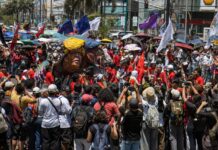
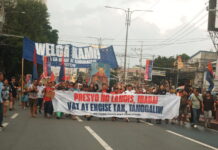
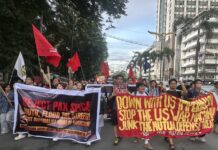
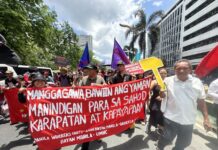






In what appears like a mouthful of gestures, metrics, and rehearsed optimism that shaped President Ferdinand Marcos Jr.’s fourth State of the Nation Address (SONA), one absence was louder than any applause. Sure, it wasn’t just what he left unsaid. It was who wasn’t there.
Vice President Sara Duterte skipped Marcos Jr.’s SONA for the second year in a row, saying she saw no point in attending: “I don’t think he will be providing anything substantial about our country.”
“We have no obligation to listen,” she dismissed when reminded that it was her duty as the second-highest official of the land.
On the day of the SONA, she was in South Korea. A move that signaled more than absence but an intentional rupture.
Once marketed as the unbeatable tandem of two dynasties, one born of a dictatorship legacy while the other of provincial authoritarianism, Marcos Jr. and Duterte now stand on opposite ends of a fractured alliance. Yet where Duterte has chosen provocation, Marcos Jr. prefers calculated restraint. He said nothing of her impeachment complaint. Nothing of her budget controversies. Nothing of the Supreme Court’s controversial ruling that junked the case. Just silence.
But silence, in politics, is not neutrality. It is positioning.
The impeachment complaint filed against Duterte was backed by over 215 lawmakers, many of them former Duterte allies.
Such a complaint was far from baseless, stemming from the gross misuse of over P612.5 million in confidential and intelligence funds (CIF), which were funneled through her offices as Vice President and Education Secretary. The funds, released and reportedly spent within mere days, raised serious questions. Committee hearings uncovered suspicious “recipients” with absurd names such as “Mary Grace Piattos,” “Chippy McDonald,” and “Carlos Miguel Oishi.” And Duterte’s defense? These were aliases. Her tone? Mocking.
This was not merely a budgeting issue. It was a depiction of impunity.
In truth, the Supreme Court’s decision to strike down the impeachment complaint does not absolve Duterte of her absurdity and anomalies. Various progressive solons, lawyers, and groups have condemned the so-called constitutional one-year ban on the impeachment case against Duterte, arguing the jurisprudence, particularly the 2003 Francisco v. House of Representatives ruling, which was ignored if not outright distorted.
Makabayan bloc further warned of its implications, that impeachable officials could now evade scrutiny not through truth but through technical gamesmanship.
Meanwhile, Duterte also remains entangled in yet another scandal. Her very own admission, delivered before the press, that she once considered hiring an assassin to kill President Marcos, his wife, and House Speaker Romualdez if anything happened to her. Though she later claimed this was only hypothetical. Her reaction has only furthered public alarm upon refusing to face various congressional inquiries.
And lest we forget, her father, Rodrigo Duterte, remains under investigation by the International Criminal Court for crimes against humanity tied to his deadly “war on drugs.”
The same machinery of impunity now appears to shelter the “daughter” aided this time not just by political loyalty but by judicial retreat.
On the other side of this cracked alliance, Marcos Jr. and his camp are busy rewriting history. Three years since Marcos Jr. sat in power, his family and their cronies have achieved record-high court victories in ill-gotten wealth cases. Decades of legal battles, meant to recover assets plundered under the dictatorship, are now unraveling in quiet courtrooms and met with adamant decisions due to “technical lapses,” judicial delays, and the government’s seeming disinterest. The outcome? Billions once ruled as stolen are now returning to the pockets of the powerful.
This is the face of political dynasties in the Philippines: one side provoking, the other erasing. One keeps the noise going, the other keeps mum. However, both play the same game and dirty theatrics. Shielding each other when convenient, attacking when strategic, never dismantling the system they jointly benefit from.
The crumbling of the Uniteam should also not be mistaken for a political awakening. It is a dynastic turf war, nothing more. Their quarrels do not reflect ideological divides, but a contest over control of budgets, of networks, of narratives. In the end, it is not about which dynasty stumbles or which faction wins the latest power play.
The real story is who keeps paying the price: It is the workers whose wages can’t keep up with prices. It is the students locked out of decent education. It is the farmers left to fend off debt, landlessness, and displacement. It is the communities militarized in the name of “peace and order”. All while the political bureaucrats move untouched.
Whether Marcos or Duterte takes the podium or the fall, the burden stays with the people, especially the marginalized.
In Marcos Jr.’s SONA, that silence told us everything. It became a policy of whose interests are defended, whose crimes are ignored, and who gets left behind.
The Filipino people can no longer afford to be spectators, especially not to their drama; worse, their impunity. Because the more noise they make at the top, the more they hope we’ll forget where the real struggle lives. On the ground, among us.


