







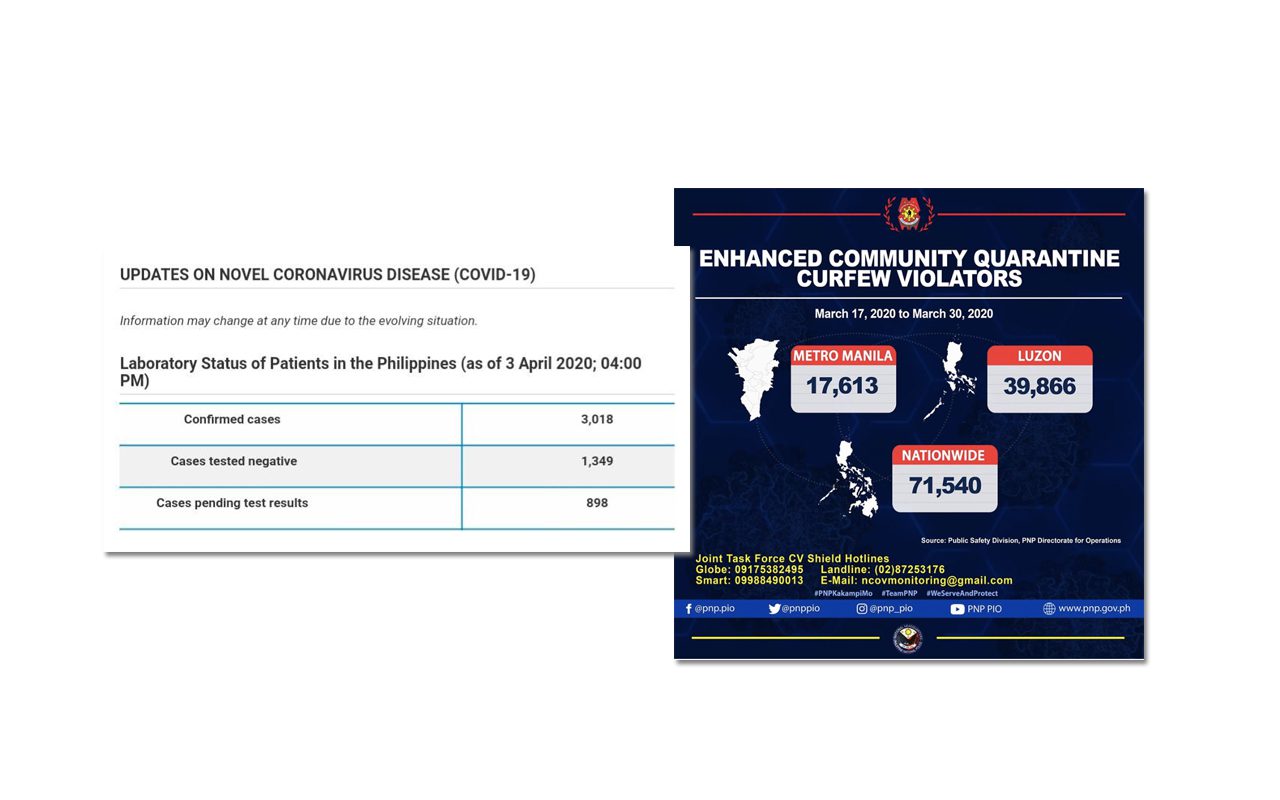
Nine days before the enhanced community quarantine (ECQ) in Luzon ends on April 12, 5,627 Person Under Investigation (PUIs) were tested according to the Department of Health (DOH) since the COVID-19 cases in the country first appeared on January 30. Meanwhile, 71,540 community quarantine curfew violators nationwide were recorded by the Philippine National Police (PNP) from March 17 to 30. Of this number, 17,039 were arrested.
More than five thousand tested
According to the DOH NCOV Tracker, as of April 3, 2020, 4:00pm (PST), 5,267 PUIs tested, 3,018 confirmed cases, 1,209 (PUIs), 52 recovered, and 136 deaths.
The data on the NCOV Tracker only became available by April 4, but earlier when it was supposed to update at April 3, 4pm, there were no indicators for those tested and no data for persons under monitoring (PUMs) and PUIs.
When it was updated today, the indicators in the NCOV Tracker changed on April 4. It used to display persons tested, confirmed cases, PUIs and PUMs, deaths and recoveries.
DOH Data as of April 2 showed that 4,726 people have been tested for COVID-19. PUIs number to 1,154 and 6,321 others are under monitoring.
Of the 4,726 tested as of April 2, 2,633 were confirmed positive or a rate of 56%. The 44% were known then as those who tested negative or are still awaiting results.
By 6pm of April 3, when there was no data on the DOH NCOV Tracker for tests, PUMs and PUIs, National Task Force COVID-19 Chief Implementer and Presidential Peace Adviser Carlito Galvez, Jr. said in an interview with CNN Philippines, mass testing is ongoing.
He said, “Ongoing na po ang mass testing. 16,368 na po ang na-test natin.”
It was only a few hours after he said that government is eyeing starting massive testing on April 14, which was two days after the ECQ ends and a day after the community quarantine in the National Capital Region ends. This would be brought about by their efforts to fast-track the accreditation of laboratories. There are currently eight (8) testing centers in the country.
On Saturday, DOH Health Undersecretary Maria Rosario Vergeire said 19,000 individuals were tested for COVID-19.
“Meron na tayong 19,000 plus unique individuals that we have tested. Meron na tayong positibo na lumabas na nasa 3,749,” Vegeire said in an interview on Dobol sa News TV.
She explained that the number of positive results do not match with the number of COVID-19 positive cases because some tests are being repeated while an individual is admitted for monitoring purposes.
The number of persons tested is as of now unclear, as the DOH NCOV Tracker (5,627), Galvez (16,378) and Vergeire (19,000) gave different figures and possibly parameters. The public had understood before the data on the NCOV Tracker to mean unique individuals.
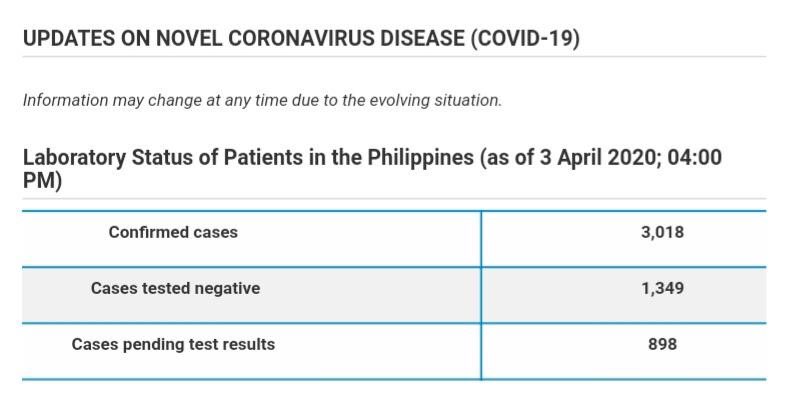
Another set of data on the DOH website on “laboratory status of patients in the Philippines as of April 3, 4pm, when added up showed 5,265 tested.
Vergeire said the government’s Research Institute for Tropical Medicine that used to be the only testing center can test 1,000 per day, while the sub-laboratories 200 per day and those that just started at 40 per day. The country can now conduct 2,000 tests per day, she said.
Aside from the RITM, the four sub-laboratories are San Lazaro Hospital, Baguio General Hospital and Medical Center for Luzon, Vicente Sotto Memorial Medical Center for Visayas, and Southern Philippines Medical Center for Mindanao.
Other accredited testing centers as of April 3 included the UP National Institutes of Health, Lung Center of the Philippines, and Western Visayas Medical Center.
Filipinos have been clamoring for mass testing since the confirmation of local transmission of COVID-19 in the Philippines in the first week of March. The call heightened during the announcement of the lockdown in NCR on March 12, the steady increase of cases amid the lockdown and despite the country’s small capacity of tests and the exposé on VIP testing, that the DOH denied.
Politicians and top government officials, their spouses, families or entire staff revealed to have gotten themselves tested despite being asymptomatic or not falling within the DOH’s triage system for testing—where only PUIs with mild symptoms who are elderly or other medical conditions and PUIs with severe symptoms were tested.
Tens of thousands recorded violating curfew, 17,039 arrested
The PNP recorded 71,560 community quarantine curfew violators from March 17 to 30—they were warned, fined or arrested. Of the number, 17,613 came from Metro Manila and 39,866 from Luzon.
Meanwhile, from March 17 to 29, 2020, the PNP reported that a total of 17,039 individuals have been arrested nationwide for curfew violation or disobedience.
Task Force COVID-19 Shield Commander and PNP Deputy Director for Operations Lt. Gen Guillermo Eleazar once said that curfew violators would not be arrested, but cased would be pursued against them after the ECQ.
Just a day after his statement, Eleazar backpedaled on the decision and said that they will continue with the arrests of curfew violators.
The increasing number of curfew violators and the activation of the online inquest proceedings of the Department of Justice (DOJ) prompted them to reconsider its decision not to arrest and detain the violators of home quarantine rules.
“Based on our assessment, the number of curfew violators will just continue to rise if we become lenient on them. This will definitely defeat the purpose of the declaration of the Enhanced Community Quarantine which President Duterte approved purposely to contain the COVID-19,” he said of their change of decision.
PNP Chief Archie Gamboa, according to Eleazar, approved the following recommendations on the handling of curfew violators:
- To coordinate with the Local Chief Executives (LCEs) for the identification of the temporary detention center big enough to observe social distancing for arrested curfew violators;
- To coordinate with the LCEs on proper disposition of arrested curfew violators based on the penalties stipulated in the LGU’s ordinances;
- If the curfew violators will be released over a decision that the regular filing of the case will be done after the ECQ, curfew violators must be held for a maximum of 12 hours while being admonished so as to deter them from repeating the offense; and
- No physical punishment must be imposed on arrested curfew violators.
Rights group condemns mass arrests
“The homeless and the urban poor are bearing the brunt of this government’s continuing neglect of social services amid the COVID-19 pandemic. They are facing threats both to their health and livelihood and they are being driven to mass hunger — but instead of addressing their urgent and legitimate demands for aid, the State is lightning quick to unleash ruthless violence and repression upon the people,” Karapatan Secretary General Cristina Palabay said.
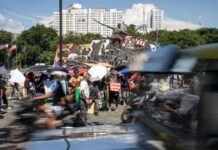
Human rights alliance Karapatan urged the release of 21 residents arrested from the urban poor community of Sitio San Roque, Barangay Bagong Pag-asa in Quezon City after around 150 residents went out to EDSA and demanded for relief goods that they have not received more than two weeks into the lockdown. The relief goods eventually came a day after the protest.
“So we’ll throw them in jail. No mercy for them,” Department of Interior and Local Government Secretary Eduardo Año said on April 3.
Año also serves as the National Task Force COVID-19 command center Vice Chair.
On April 3, Quezon City prosecutor Irene Resurreccion-Medrano recommended the filing of five separate charges against the accused for:
- violation of the public assembly law [BP880]
- non-cooperation under RA 11332
- disobedience of a lawful order [Art. 151 of the Revised Penal Code]
- spreading of false information under the Bayanihan Act [RA 11469], and 5) impeding access to roads also under RA 11469. It was swiftly approved and filed with the Metropolitan Trial Court of Quezon City.
The bail is fixed at P3,000 per count for the charges, totaling at least P15,000 per accused, according to National Union of Peoples’ Lawyer Atty. Kristina Conti.
Netizens raised the P15,000 bail for the arrested, with singer Frankie Pangilinan pledging to bail one, her parents Senator Francis ‘Kiko’ Pangilinan III and Sharon Cuneta to bail 20, actress Jodi Sta. Maria pledging for four and many others.
Karapatan also cited the case of public school teacher Juliet Espinosa, 55, who was arrested in General Santos City on March 27 and was charged with inciting to sedition for her alleged Facebook post which also aired her grievances on mass hunger.
“Mass arrests will not and do not address mass hunger caused by the government’s own neglect of people’s welfare. We demand the release of the arrested residents of Sitio San Roque. In failing to deliver on promises of socio-economic aid for the marginalized and meeting their demands with arrests, violence, and human rights violations, the Duterte administration is only exacerbating social unrest and the people’s discontent with his anti-poor and fascist rule,” said Palabay.
What is the plan
On March 30, after Duterte’s first report to Congress a week after he was granted additional powers including moving P275 billion of funds from the national budget to go to COVID-19 response, people found his public address lacking of concrete plans and the breakdown of where the P275 billion has been used so far.
Former Anakpawis representative Ariel Casilao said around P995 billion could be at the president’s disposal.
Casilao said, “Aside from the P275B Bayanihan We Heal As One fund approved by Congress, available budget from various departments and agencies tapped for the [COVID-19] response include the following:
- P200B from GOCCs for social amelioration
- P100 -180B Savings from the 2019 budget
- P300B BSP government securities”
Galvez gave a broad outline of the National Action Plan (NAP) that targets to “flatten the curve” on March 27. Galvez explained the NAP focused on four lines of effort: an enhanced community quarantine, enhanced monitoring and response, responsive sustainment, and crisis communication.
He was appointed as National Task Force COVID-19 Chief Implementer the day before. The Inter-Agency Task Force on Emerging Infectious Diseases (IATF) headed by the DOH, who has been meeting, deciding and communicating with the public the government’s response to the COVID-19 outbreak is now the policy making body of the National Task Force COVID-19 headed by Department of National Defense Secretary Delfin Lorenzana.
Galvez sought a hundred days to flatten the curve of COVID-19 pandemic and to enhance the country’s healthcare system. The plan’s purpose is to stop the spread of the pandemic crisis.
“Our focus is to save humanity. Itong health crisis na ito ay talagang napaka-vicious at highly contaminated,” he said.


