

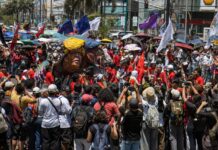
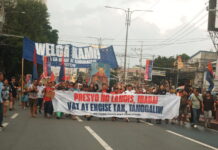
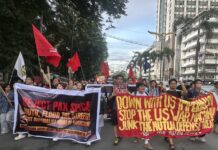
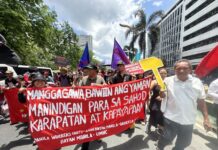






“Alam natin na ang mga militaristic ways of approaching anything ay very masculine. Even yung ROTC, within the military institutions, very macho or masculine yong pinopromote na values,” said Anna Cubacub, an LGBTQIA+ advocate.
[We know that militaristic ways of approaching anything are very masculine. Even in the ROTC, within military institutions, values promoted are very macho or masculine]
The Reserve Officers Training Corps (ROTC) is a program of the Department of Education (DepEd), Commission on Higher Education (CHED) and Armed Forces of the Philippines (AFP), within public and private tertiary institutions that aims to prepare youth as army reserves and soldiers should armed conflicts break out inside or outside the country.
Last December 2022, the House of Representatives (HOR) approved House Bill No. 6687, or the National Citizens Service Training Program (NCSTP), on its third and final reading. The said bill mandates tertiary education students to undergo a two-year comprehensive military training. However, many students noted such training as an “ROTC in disguise”.
On the other hand, the Sexual Orientation, Gender Identity, Gender Expression, or Sex Characteristics (SOGIESC) Equality Bill has been pending in HOR for over 20 years now.
What’s enforced versus the true need
Since 1994, the LGBT+ community in the Philippines has been advocating for their human rights, marked by the first Pride March on June 26 of that year.
Six years later, in 2000, the SOGIE Equality Bill faced repeated failures to be ratified despite efforts.
Related articles:
This legal battle for LGBTQIA+ rights spans over two decades in contrast to the swift approval of MROTC. This year, the SOGIESC bill has been approved by the House Committee on Women and Gender Equality after the panel accepted the substitute bill crafted by the technical working group (TWG).
Progressive solons from the Makabayan bloc like Gabriela Women’s Partylist, Kabataan Partylist and ACT Teachers Partylist lauded the approval; however, affirming that this is a step towards the long-overdue enactment of legislation that will prohibit all forms of discrimination and harassment against the LGBTQIA+ community.
“Naninindigan kami na karapatan ng bawat miyembro ng LGBTQIA+ na makatamasa ng pantay na karapatan sa edukasyon, trabaho, serbisyong kalusugan, at iba pa ng walang takot at pangamba,” said GWP representative Arlene Brosas.
On the other hand, the congress would also seek to institutionalize the four-year optional ROTC program with the Department of National Defense (DND) and Commission on Higher Education to design the curriculum. This is in addition to the recently passed NCSTP.
Last February 6, DND proposed to the Senate the five-year phase program design with a whopping P61.2 billion estimated fund before the said ROTC implementation.
- Phase 1 (2023) – P5,240,000
- Phase 2 (2024, Q1 to Q3) – P5,542,498,579.20
- Phase 3 (2024, Q4; 2025, Q1 to Q3) – P14,861,591,011.20
- Phase 4 (2025) – P20,384,338,579.20
- Phase 5 (2026) – P20,384,338,579.20
“MROTC and the AFP itself have a long history of violence — from corruption, hazing, red-tagging, to the deaths of our fellow youth. Accordingly, this program will aggravate state violations of human rights under the Anti-Terror Law,” said Lumansag, an alliance network of various students, rights groups and defenders that reject the proposal for the returning of MROTC.
In the Universal Periodic Review, fourth cycle for 2022, 62% who identified as part of LGBTQIA+ community were discriminated, 51% of the number transpired in public schools, 31% in streets, 28% in private schools 25% in their neighborhood and 19% in churches.
SOGIESC-based violence in schools those reported incidents were mostly physical and sexual threats and abuse at 22.9% followed by voyeurism through photo or video and online bullying at 20% discriminatory or stigmatising remarks 17.1% and misgendering at 8.6%.
The LGBTQIA+ alliance group Bahaghari seconded that imposing mandatory ROTC will only reinforce a culture of blind obedience and false “nationalism” while promoting a militaristic and macho-feudal environment that suppresses critical thinking in schools in addition to the harassment, corruption, and violence, especially towards LGBTQ+ students.
According to the group, MROTC will further burden students, parents, and school staff in facing an economic crisis with the inflation rate pegged at 4.9% in October.
While this is observed as a ‘slowdown’, the average inflation from January to October still stands at 6.4% which is far from the government’s target band of 2% to 4%.
What needs to be done
Active engagement can have a profound impact beyond one’s expectations. When addressing public concerns, active engagement through activism serves as an effective means of expressing and underscoring people’s needs and criticisms of the government.
Cubacub noted there is a disparity between upholding gender equality and justice and the railroading of MROTC, saying that masculine values are already rampant most especially at the helm of institutionalizing ROTC.
“Bakit hindi nalang SOGIE equality trainings ang ipasa, rampant na yung masculine values, macho values na further lang narereistate at nadidiin kapag may ROTC,” she added.
[Why not just pass SOGIE equality trainings? Masculine values, and macho values are already rampant, and these would only further emphasize in ROTC]
It could also be remembered when Sen. Bato dela Rosa made a statement that MROTC would instil “gender equality” among the youth last September.
According to Bahaghari, the “gender equality” in Sen. dela Rosa’s proposal is simply men and women equally being exposed to the same anti-woman, anti-LGBTQ+, and anti-democratic culture which is the ROTC program.
“Lest we forget our history, there is no such thing as ‘gender equality’ in ROTC. If Senator dela Rosa wants gender equality to be an ideal among the youth, the first step is not militarization, but strengthening our education on gender sexuality as well as human rights. If he wants patriotism to be an ideal among the youth, let us strengthen our education on the Filipino language, culture, and history. Teach children about the centuries and generations of Filipinos standing up for sovereignty, refusing to be slaves and playthings to people in power,” Bahaghari emphasized.


