

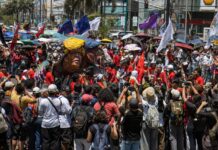
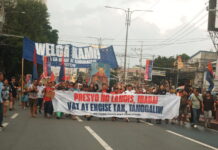
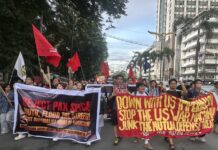
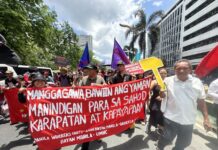




Throughout the pandemic, the Filipino people saw and experience various attacks on their rights and civil liberties through President Rodrigo Duterte’s policies. Our rights and civil liberties are sbeing eroded in the name of the pandemic or swept away with the health and economic crisis.
The Duterte administration was able to shut down ABS-CBN, the biggest broadcast network in the country, through his supermajority in the Lower House of Congress. They were able to red-tag independent and alternative news outfits through the president’s creation, the National Task Force to End Local Communist Armed Conflict. They were able to arrest and jail community journalists like Manila Today editor Lady Ann Salem and a handful of other activists with the use of a combination of the courts, the law and the police.
The Duterte administration’s most recent incursion is the military intervention and attacks on university libraries in Northern Luzon and Western Visayas.
Throughout September 2021, the Philippine military ordered university libraries to remove books and documents on the ongoing Philippine Civil War and peace negotiations between the Philippine government and National Democratic Front of the Philippines (NDFP).
The 50th Infantry Battalion inspected Kalinga State University (KSU) that led librarian Evangeline Cabello purging the books last September 1, 2021. This is despite Cabello stating: “I think some of those books should not have been removed from the library.”
Col. Leandro Abeleda of the 502nd Infantry Brigade monitored Isabela State University (ISU) ordered the purge of these books last September 20, 2021. The books were later surrendered to the National Intelligence Coordinating Agency (NICA) and Regional Task Force to End Local Communist Armed Conflict (RTF-ELCAC).
Finally, Aklan police and Western Visayas RTF-ELCAC commanded Aklan State University (ASU) to remove these books last September 24, 2021.
Some of the following books and documents censored include:
- Defeating Revisionism, Reformism, and Opportunism
- Building People’s Power
- Crisis Generates Resistance
- Building Strength through Struggle
- The Declaration and Program of Action for the Rights, Protection and Welfare of Children;
- Comprehensive Agreement on Respect for Human Rights and International Humanitarian Law (CARHRIHL); and
- The Government of the Philippines-NDFP Peace Negotiations Major Arguments
Ironically enough, these materials censored and seized by the RTF-ELCAC are books and documents signed by Philippine government representatives that are essential in recording our nation’s peace process. Even international websites such as the International Committee of the Red Cross and the United Nations’ sites have made these books and documents easily accessible online to document the development of peace talks.
Yet, academic institutions (or any institution for that matter) have the right to establish and assert what books remain in their library and how they teach these materials.
The Armed Forces of the Philippines (AFP), Philippine National Police (PNP), and other state forces are only mandated to enforce laws and follow orders on war or orders of the president. They have neither the authority nor the competence to dictate what academic institutions should and should not teach.
Such a thing happening to our country under Duterte’s rule is reminiscent of the banning of books in the colonization era (centuries removed) or the burning of books in countries ruled by known dictators in the world in the past century—a tragically antiquated way of trying to control how people think. Locally, this is reminiscent of the banning of books during the early neo-colonization years and banning of anything anti-Marcos and the attacks on the mosquito press during martial law.
When dictator Ferdinand Marcos, Sr. declared martial law on September 21, 1972, his first command was the closure of all newspapers, magazines, radio, and television. Along with that was the suppression of organizations within academic institutions and removal of academic literature on freedom of speech and the like. While the only media permitted to operate were those controlled by Marcos cronies such as media outlets owned by Imelda’s brother Benjamin Romualdez, Marcos’ aide Hanz Menzi, and crony Roberto Benedicto.
As such, the mosquito press rose under Martial Law to counter the pro-government private press and the Marcos dictatorship itself. Student publications under College Editors Guild of the Philippines (CEGP) relentlessly chose to write for the people and the nation. Other press such as Ang Pahayagang Malaya, Signs of the Times, and revolutionary papers Ang Bayan and Liberation also did the same. They are what was then truly the mainstream press as they were able to penetrate the masses, even those in far-flung areas in the countryside.
Just as how the academe and the mosquito press fought, it is up to us today to actively decide what to do when confronted with tyranny on all fronts—against our right to live, or even what to read or think.
Heck, banning of books was even the way Communist Party of the Philippines founder Jose Maria Sison found his way to ideologies that counter the current world setup and the ways to change society, leading to his own study on how to change Philippine society. These are what the government are preventing us from knowing, whether it is from NDFP books, activists’ dissent, or critical media content: the ways to change the status quo or to even just allow us realize our place in it as among the oppressed which might lead us to eventually want to change it.
That said, it is all the more important to openly discuss the civil war, as any discussions on this reality—the more than 50-decades civil war in the country—has been distorted as the government exerts all efforts to silence ideas contrary to the status quo, and continues to fudge freedom of expression, academic and press freedom.
Banning of books and limiting discourse is no small deal. We should realize this now lest we see the country again covered up with the façade of “the true, the good, the beautiful” or histories re-written to fete tyrants and dictators and their regimes tagged as golden ages.
The people may have been too sick or too inundated with COVID-19, hunger, joblessness or lockdown blues to have the stamina to fight for the loftier, out-of-home, or not personally experienced rights violations. But those who are able must continue to fight for our rights, until the rest of the country can join this struggle.


