







When President Marcos Jr. declared that the catastrophic impacts of typhoons and extreme weather are the “new normal,” he effectively admitted to the government’s structural failure in disaster risk management—a damning display of the state’s neglect of its duty to protect its people.
As the country grapples with the devastation brought by Typhoons Crising, Dante, and Emong, along with the intensified Southwest Monsoon (Habagat), Filipinos look to the government for reassurance and accountability. Instead, the President offered a weak-willed response: “Ganito na talaga ang buhay natin kahit ano pa ang gawin natin,” as if there is nothing more the state can do. It’s a stark contrast to the supposed promise of his regime — Bagong Pilipinas.
It’s unacceptable—shameful, even—to hear such words from the President, especially in the face of staggering numbers: 2,733,646 individuals or 765,869 families affected and counting. Meanwhile, around 40 cities and municipalities have already declared a state of calamity.
During disasters, it’s always the most vulnerable sectors that bear the brunt. Over 20,000 farmers and fishers have been affected, with losses amounting to ₱454.12 million in agricultural damage, according to the Department of Agriculture (DA) and Disaster Risk Reduction and Management (DRRM).
Aside from economic losses, it is crucial to account for how education is affected. The learning disruptions caused by educational policies that fail to consider our climate realities are deeply troubling. Teachers and students remain deprived of a quality education system that can withstand the impacts of recurring calamities.
While it’s true that natural calamities are inevitable, it’s not an excuse for the Marcos regime to continue the cycle of neglect that has made the country a calamity punching bag. The cyclical loss of life, property, and livelihood is inexcusable. Filipinos deserve better than a government that cements neglect and incompetence as policy.
A country long in the grip of calamity
Annually, around 20 typhoons enter the Philippine Area of Responsibility (PAR), making it a gateway to tropical systems from the Pacific Ocean. On top of that, the country sits right within the Pacific Ring of Fire, a hotbed of earthquakes and volcanic activity. As far as geography is concerned, we are a nation constantly in the path of natural disasters.
In 2024, the World Risk Index (WRI) ranked the Philippines as the most disaster-prone nation globally. The country has topped the list for 16 consecutive years, underscoring just how crucial it is for the government to prioritize building the foundations of an effective disaster management system—one that, until now, remains unimplemented, if not entirely non-existent.
We need systems that equip communities before disaster strikes, not elected officials who scramble for press conferences after lives are already lost.
History teaches us that flooding, typhoons, earthquakes, and volcanic eruptions have long been part of Filipino life. Culturally, we’ve learned to adapt—living in elevated homes like the bahay kubo, designed with the understanding that many communities are near rivers or coastlines where flooding is a familiar reality, or in typhoon-resilient Bahay na Bato dwellings built by the Ivatans in harmony with the tropical climate. Yet we have strayed too far from these roots. Time and again, our governments have ignored indigenous wisdom, favoring market-driven urban development over the needs of the people.
It’s difficult to grasp how a country with such a rich historical and cultural memory continues to fall short in responding proactively to the risks posed by recurring calamities. As President Marcos Jr. himself said, “This is not an extraordinary situation anymore.” Shouldn’t that statement serve as a wake-up call for authorities to finally develop and implement solutions, rather than treat it as a cue to simply accept the situation as a perennial reality?
The toll of corruption and anti-people governance
While vast areas of the country and thousands of Filipinos have been submerged in floodwaters since early this week, President Marcos Jr. was notably absent during this critical time and went ahead with a meeting with U.S. President Donald Trump. In return, he secured only a measly 1% reduction from the original 20% tariff rate. Meanwhile, Trump boasted that the Philippines would now have zero tariffs for U.S. goods. Marcos Jr. later clarified that the agreement only covers automobiles, soy, wheat, and pharmaceutical companies. This is economic sabotage, a sellout, and an insult that adds salt to the wound.
Vice President Sara Duterte, who holds the second-highest office in the country and is expected to show leadership in times of national crisis, is instead spending her time in The Hague, Netherlands, visiting her father, former President Rodrigo Duterte, who is detained for alleged crimes against humanity. This is a clear dereliction of duty. It appears that personal business is being prioritized over the welfare of the Filipino people during difficult times.
According to reports, ₱1.14 trillion has been allocated to flood control projects since 2015. Nearly half of this amount was spent under the Marcos Jr. administration. Yet flooding across the country has only worsened, despite these massive budget allocations intended to mitigate it.
What’s even more concerning is that funds continue to be funneled into these programs despite a consistent decline in budget utilization over the years, based on government reports. This comes with the usual project delays, cancellations, cost overruns, and pork-barrel insertions. In a system rife with corruption, basic public services, like disaster response, become predictably unreliable.
A new normal that Filipinos deserve
Environmental destruction through mining, land-grabbing, quarrying, and deforestation is enabled by policy, driven by profit, and paid for by the poor. This deliberate plunder displaces communities, destroys livelihoods, and ultimately costs lives.
For far too long, Filipinos have endured a government that not only neglects their needs but also weaponizes their resilience. As tragic as it is inspiring, resilience often comes from having no choice but to endure the failures of a broken system. People have simply grown too accustomed to being abandoned by those in power.
However, the country’s fate, bleak as it may seem, is not sealed. Collective voices surely have the power to challenge the status quo. Corruption, patronage politics, and profit-driven neoliberal policies — those that favor the powerful few at the expense of the people and the environment— must be dismantled. Only then can we begin to build systems that genuinely serve the people.
Come Monday, July 28th, President Marcos Jr. will deliver his fourth State of the Nation Address (SONA). We can expect misrepresentations and illusions of progress. He may boast of his administration’s so-called accomplishments, but the real story is told by the masses—by the daily struggles of minimum-wage earners, by students and teachers forced to learn and teach in dilapidated schools, and by Indigenous communities displaced by corporate land-grabbing.
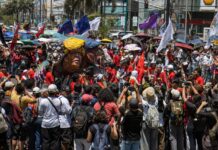
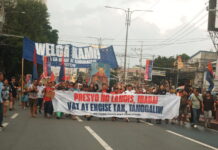
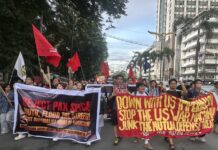
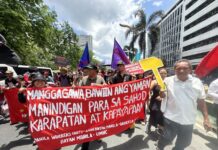
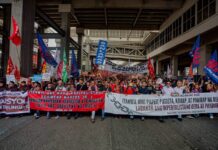
As people march together in the streets and lay bare the true state of the nation, the government has to listen, for there is nothing normal about the death and destruction caused by predictable natural disasters. There is only so far resilience can carry a people; it has been stretched thin for far too long. What we must demand now is a culture of accountability, a commitment to environmental justice, and a government that puts people’s interests at the center. That is the new normal Filipinos deserve.


