

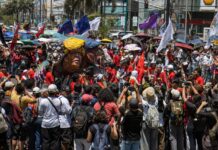
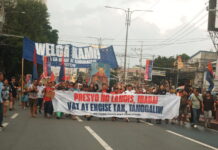
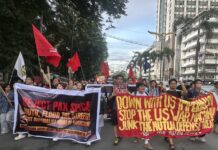






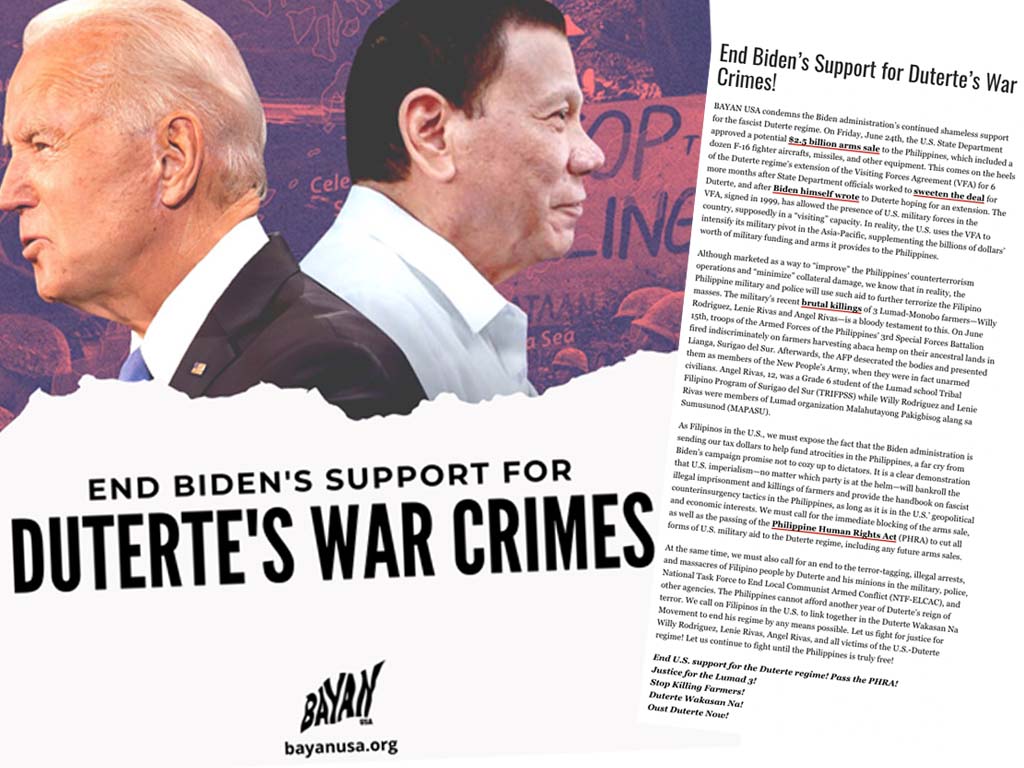
“BAYAN USA condemns the Biden administration’s continued shameless support for the fascist Duterte regime,” the group said in a statement on June 29.
On June 24, the U.S. State Department approved a potential $2.5 billion arms sale to the Philippines, which included a dozen F-16 fighter aircraft, missiles, guns, countermeasures gear (survivability from attacks), and other equipment.
“This proposed sale will support the foreign policy and national security of the United States by helping to improve the security of a strategic partner that continues to be an important force for political stability, peace, and economic progress in South East Asia,” said in the public contract.
This will also require the provision of technical support for maintenance operations and to conduct flight and maintenance training to the Philippines from the US government and the contractor.
“Although marketed as a way to ‘improve’ the Philippines’ counterterrorism operations and ‘minimize’ collateral damage, we know that in reality, the Philippine military and police will use such aid to further terrorize the Filipino masses,” assailed BAYAN USA.
Changing Ph presidents but similar policies towards US
Duterte’s six-year term has seen three changes in the US presidency.
He publicly cursed former US President Barrack Obama who was critical of the human rights situation in the Philippines.
He praised and serenaded former US President Donald Trump, but continued with close ties with US rival China and issued notice to cancel the Visiting Forces Agreement (VFA) in February last year.
He is currently negotiating the VFA with new US President Joe Biden, asking the US “to pay more” and “to quadruple its military aid.” The Philippine government was said to be demanding $16 billion in aid in February this year to resume VFA. Some have called this “extortion.” But a similar negotiating tact was observed earlier when the late Pres. Corazon Aquino tried to start talks over a new US bases treaty in 1989, demanding $1B from the US, which the US then referred to as “cash-register diplomacy.”
Philippine Ambassador to the US Jose Manuel Romualdez said early this month that Biden wrote to Duterte for the occasion of the 75th anniversary of US-Philippine ties this coming July and hoped for VFA extension.
Duterte has twice suspended the cancellation of the VFA, which was needed to operationalize and implement the 1951 US-Philippines Mutual Defense Treaty. The VFA provides the legal framework for US troops, transport, and equipment can enter and operate in the Philippines. The cancellation of the VFA was first suspended in June last year. Duterte suspended the termination of the VFA again up to February 2022, announcing it just a few days after the 123rd Philippine Independence Day.
The VFA was signed under former President Joseph Estrada in 1999, only a few years after the repudiation of US bases in the country, the last of their military physical basing and vestige of their direct colonization of the Philippines. Estrada was one of the 12 senators who voted to abrogate the US bases treaty.
Duterte decided to scrap the VFA following the US visa cancellation of close ally Sen. Ronald “Bato” Dela Rosa, over his chief role in Duterte’s bloody war on drugs. The Philippines sent the US a notice to terminate the VFA in February 2020 and it would have expired in August 2021.
Despite the VFA in limbo, Balikatan exercises between the US troops and the AFP resumed in April this year, after having been suspended last year due to the COVID-19 pandemic.
Changing US presidents but unchanged policy towards Ph
“The VFA has allowed the presence of U.S. military forces in the country, supposedly in a ‘visiting’ capacity. In reality, the US uses the VFA to intensify its military pivot in the Asia-Pacific, supplementing the billions of dollars worth of military funding and arms it provides to the Philippines,” explained BAYAN USA.
A testament to this, the group said, is the Lianga 2 massacre, where 3 Lumad-Manobo farmers were killed on June 15.
“As Filipinos in the U.S., we must expose the fact that the Biden administration is sending our tax dollars to help fund atrocities in the Philippines, a far cry from Biden’s campaign promise not to cozy up to dictators,” said BAYAN USA.
To them, this is a clear demonstration that “US imperialism—no matter which party is at the helm—will bankroll the illegal imprisonment and killings of farmers and provide the handbook on fascist counterinsurgency tactics in the Philippines, as long as it is in the U.S.’ geopolitical and economic interests.”
“We must call for the immediate blocking of the arms sale, as well as the passing of the Philippine Human Rights Act (PHRA) to cut all forms of U.S. military aid to the Duterte regime, including any future arms sales,” said the group.
They said they are also calling for “an end to the terror-tagging, illegal arrests, and massacres of Filipino people by Duterte and his minions in the military, police, National Task Force to End Local Communist Armed Conflict (NTF-ELCAC), and other agencies.”
Ph is largest US aid recipient in the Indo-Pacific region
Despite tense ties with the US since President Rodrigo Duterte rose to the presidency, the Philippines is the largest recipient of US military aid in the Indo-Pacific region according to the US Embassy in the Philippines.
Since 2015, the US has delivered more than P37 billion ($765 million) worth of planes, ships, armored vehicles, small arms, and other military equipment to the Philippines.
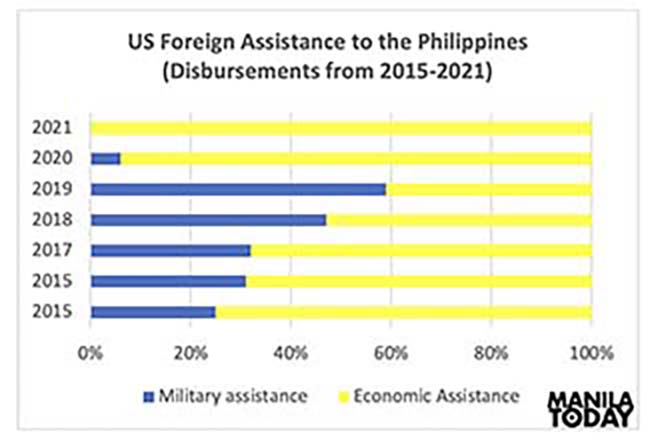
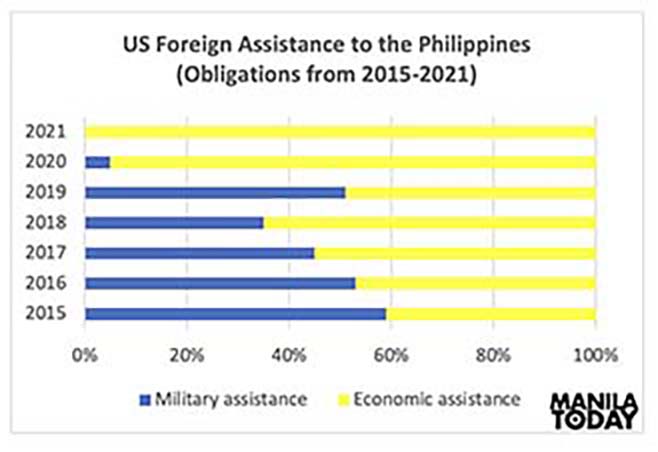
According to USAID, US foreign assistance is categorized as either military or economic assistance. Military assistance is any assistance that primarily benefits a recipient country’s military capability. Economic assistance is any assistance with a development or humanitarian objective.
US foreign assistance disbursements to the Philippines from 2015 to 2021 reached $1.9 billion, as published on the USAID website. Of which, $600 million was disbursed for military aid.
More than $ 1.7 billion were reported as US financial obligations to the Philippines from 2015 to 2021 according to USAID. Of which, $741.5 million was for military assistance. Obligations are defined as “contracts for the purchase of construction, maintenance, and repair, commodities and/or services.”
In the partially reported year 2021, the Philippines ranked second to conflict-stricken Myanmar in the region in US foreign assistance disbursements and 12th of 44 lower-middle-income countries (topped by Nigeria). In obligations, the Philippines ranked second to Cambodia and 8th among 43 lower-middle-income countries (led by Zambia) in most foreign aid obligations from the US.


, and other equipment.)