

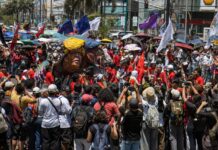
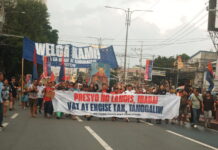
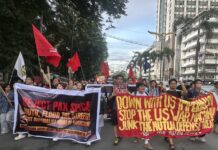
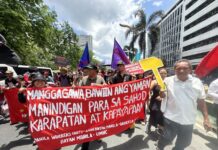



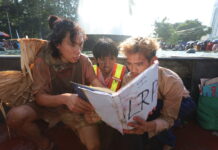


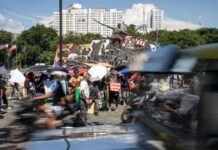
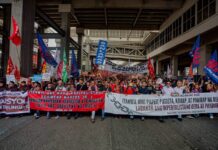


Amid heavy rains and drenched communities within Metro Manila and other regions, various environmentalists and climate advocates held a protest action to urge the need for climate accountability in the upcoming State of the Nation Address of President Ferdinand ‘Bongbong’ Marcos Jr. on July 28.

“This is the State of the Nation” and “Make Climate Polluters Pay,” said Greenpeace Philippines activists following their creative protest in a flooded community in Cainta, Rizal.

Meanwhile, small fisherfolks under PAMALAKAYA Navotas staged a picket protest in front of Navotas City Hall to lambast the ongoing construction of the 650-hectare Navotas Coastal Bay Reclamation Project led by the local government of Navotas and San Miguel Corporation.
“Ramdam na ramdam namin mga mangingisda at mamamayan ng Navotas ang pagtatambak sa dagat. Tinanggalan na kami ng kabuhayan, tapos ngayon pinepeste kami kasi isa ito sa nakikita namin dahilan kung bakit mabilis at matagal ang pagbaha sa amin. Mismong DENR ang nagpatunay niyan sa pag-aaral nito. Wala nang dahilan ang gobyerno para ituloy pa ang reklamasyon,” said PAMALAKAYA Navotas president Rommel Escarial.
About 1.5 million individuals have been affected by the ongoing extreme weather situation in the Philippines, brought about by the combined impacts since the onslaught of Typhoon Crising and the southwest monsoon or Habagat. PAGASA is also closely monitoring other weather disturbances, including Tropical Storm Dante and Tropical Depression Emong, which intensify Habagat and bring intense to torrential rains to various areas of the country.
Since the onslaught of Typhoon Crising, infrastructure and agricultural damage incurred around P413.02 million and P54.06 million, respectively.
“These protest actions staged under relentless rain come not only ahead of President Marcos’ SONA on Monday, but also ahead of a historic moment: The International Court of Justice in the Hague is set to release an advisory opinion (ICJAO) on “the obligations of States in respect of climate change” on July 23, Wednesday evening in Manila,” said Greenpeace Philippines in a statement.
According to the Center of International Environmental Law, the said international court’s opinion is deemed as “one of the most consequential legal rulings” for various climate-vulnerable countries, including the Philippines, to address the impacts of climate change.
“The Philippines is committed to shaping a global framework that ensures justice for those most affected by the climate crisis and secures a sustainable future for all,” said the Marcos Jr. administration’s formal submission to the international court.
In 2024, the Philippines was selected to host the Board of the Fund for Responding to Loss and Damage (FRLD), a financial mechanism established by the Conference of the Parties (COP) to the United Nations Framework Convention on Climate Change (UNFCCC) to assist developing countries in recovering from climate change impacts.
“Isa sa krisis ng daigdig at ng planeta ang pagkakaroon ng climate crisis. Multiple crisis na ang hinaharap natin mula 2000s, at sa multiple crisis ay tampok ang epekto ng dulot ng imperyalismo,” said IBON Foundation executive editor and head of Research Department Rosb Guzman.
Guzman stressed that industrialized countries, particularly the United States, have contributed disproportionately to global emissions and continue to evade full responsibility. Despite being a state party to the COP, the US has a historical track record of non-compliance with binding obligations, insufficient contributions to climate finance, and resistance to a decisive fossil fuel phaseout.
”Ang hindi pagpasok ng US sa mga agreement na mitigation steps na dapat gawin ng mga industriyalisadong bansa ay iyan ang dapat nating tingnan bilang sign na walang mangyayari sa ganoong negosasyon,” Guzman added.
Notably, in 2017, the US Trump administration withdrew from the Paris Climate Agreement, citing sovereignty and economic interests. Such reasoning is similar to the record of the Marcos Jr. administration, according to climate activists.
According to NILAD, an environmental group, the Marcos Jr. government has prioritized large-scale infrastructure and reclamation projects. Case in point: the ongoing reclamations in Manila Bay despite the key findings following the release of the Manila Bay Cumulative Impact Assessment (CIA) result that revealed severe environmental threats.
The Marcos Jr. administration also continues to support fossil fuel exploration and extractive industries, often framing environmental concerns as secondary to economic development. This was delivered during Marcos Jr.’s first SONA upon acknowledging support for natural gas and nuclear power expansion with no phase-out plans for fossil fuels.
Greenpeace Philippines has since lambasted these pronouncements as mere rhetoric of the Marcos Jr. administration.
“We want more than speeches. We want action. Support stronger climate policies, end support for fossil fuel expansion, and fast-track the passage of the CLIMA Bill,” said Virginia Benosa-Llorin, Senior Campaigner at Greenpeace Philippines.
CLIMA Bill is a law that holds corporations responsible for climate damages and secures justice for affected communities.
“The President must go beyond lip service and be a leader in climate justice—not just in words, but in actions that protect communities and hold corporations to account,” Benosa-Llorin added.


