

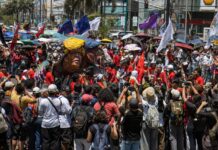
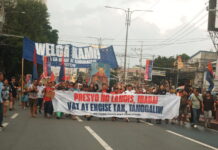
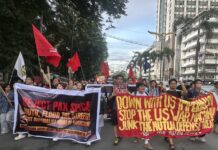
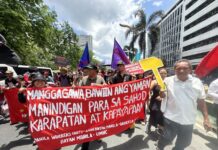







With extreme weather events battering across the Philippines, the timing of Marcos-Trump trade deals could not be worse just days before the 4th State of the Nation Address (SONA).
“The best thing Pres. Marcos Jr could’ve done was restore dignity to the Philippines,” said Sonny Africa, Executive Director of IBON Foundation.
On July 22, President Ferdinand ‘Bongbong’ Marcos Jr. met with US President Donald Trump during a three-day high-profile visit to Washington, D.C.
Both hailed the trip as a success. Trump called it a “beautiful visit,” while Marcos Jr. described it as a “significant achievement.” However, for activists and economists, Marcos Jr. has returned with one-sided trade concessions and deeper US military deals, but without real economic gains.
Export growth for whom?
In Marcos Jr.’s visit to the White House, he discussed with US President Donald Trump the 20% reciprocal tariff threatened by the US leader on dozens of countries, including the Philippines, since April this year. Trump would describe Marcos Jr. as a “tough negotiator” following the latter’s expectations for key agenda with the US president on security, defense, and trade.
The deliberations between Trump and Marcos Jr. resulted in a trade agreement that included a 19% tariff rate for Philippine goods entering the US, while the Philippines would have an open market for US goods with zero tariffs.
Last year, the US recorded a $5 billion trade deficit with the Philippines, representing a total bilateral goods trade of $23.5 billion, a 21.8% increase from the previous year. Still, the US remains the country’s top export destination, accounting for nearly 16% total exports for semiconductors and electronic products in the first five months of 2025.
“The template of tariffs on the Philippines at 19% and no Philippine tariffs on the US is grossly one-sided in favor of the most powerful economy in the world against a country that is still in the poorest one-third of the world,” said Africa.
The economist noted that things might even be worse, emphasizing that the overall tariffs on US imports are already low at around 3%. Further cuts will only yield minimal savings while harming local production.
Department of Agriculture (DA) secretary Francisco Tiu Laurel Jr. claimed that the zero tariff on US agricultural imports could support the goal of the Marcos Jr. administration in achieving a food-secure Philippines, especially for livestock production.
However, data tells a different story. According to IBON Foundation, involuntary hunger has more than doubled under the Marcos Jr. administration from 11.6% or 2.9 million families in June 2022 to 27% or 7.5 million families in March 2025.
The group attributed this sharp increase to meager incomes and the rising cost of living, noting that the P50 minimum wage hike in the National Capital Region since July 2025 falls far short of meeting basic needs in comparison to the demand for a P1,200 family living wage (FLW). All while the food prices have increased by 16% between June 2022 and February 2025.
“If the DA wants cheaper feeds, maybe it should be asked what efforts it’s doing to develop domestic feed production rather than rely on imports from the US,” Africa added.
Africa also worried if Marcos Jr. has also committed to cut tariffs on meat imports from the US, deeming that such would be detrimental to small local producers.
In the transport sector, the economist further warned that zero tariffs on US vehicles could lead to revenue losses for the country. Such an action may also provoke retaliation from other trading partners like Japan or the European Union, who could see the preferential treatment of the US as discriminatory.
The policy is also crucial in the context of the Public Transport Modernization Program (formerly PUVMP), which has seen numerous protests since last year. While the government claims the program aims to uplift the transport sector, removing tariffs on imported vehicles, particularly from the US, would only deepen the country’s dependence on foreign-made units.
Africa further noted that the policy promotes a foreign-dominated model of modernization that sidelines local industries.
“This preempts any efforts the Philippines might want to take to protect and develop a Filipino auto industry, which could be a legitimate industrial objective,” Africa said.
“It’s difficult to comment on specifics, but it’s hard to think that the current ambiguity isn’t in the US’s favor given its proven heavy-handedness in how it negotiates trade deals after the shock-and-awe of reciprocal tariffs,” he added.
A modern-day gunboat diplomacy
In a press briefing, Marcos Jr. affirmed that the US remains the country’s “strongest, closest, and most reliable ally” when asked about the military deals with the US that might be considered “escalatory” to China.
Trump, on the other hand, dismissed the concern, saying: “You (the Philippines) can deal with China. You should deal with China.”
He also hit the former Duterte administration’s pivot to Beijing.
“I think I can say that the last administration was not getting along with them too well. They didn’t get along with anybody. Honestly, they didn’t know what they were doing,” Trump said.
Former Duterte administration notably forged closer ties with Beijing after several US officials criticized the human rights violations incurred during his bloody campaign on the drug war.
Marcos Jr. was also asked about the planned US ammunition hub in Subic and the Luzon corridor. Trump then unabashedly emphasized its importance.
“It’s very important. Otherwise, we wouldn’t have approved it,” said Trump.
“This is actually (the US) assisting the Philippines in what we call our self-reliance defense program, which is to allow us to be self-reliant and to be able to stand on our own two feet, whatever the circumstances that occur in the future,” Marcos added.
Trump went further, recalling his past interventions in Philippine affairs, bragging about US military action in the country.
“Don’t forget that, just as tantamount to what you’re asking, the Philippines was loaded up with ISIS and a lot of terrorists. And they were at a very, very dangerous point. And during my administration, we went in, and we wiped them out. If we didn’t get in, I don’t know what would’ve happened… we spent a lot of time, and a lot of talent, on going into the Philippines and wiping out terrorists… and now you (Marcos Jr.) really have a good, solid country again,” said Trump.
Bagong Alyansang Makabayan (BAYAN) viewed these remarks as contradictory, especially as Trump bragged about boosting the US military dominance, while Marcos Jr. claimed that this would assist in the modernization of the Philippine military.
“This is a reminder that the US is only interested in furthering its self-serving agenda of using this so-called modernized AFP with hand-me-down war materiel to suppress the anti-imperialist movement in the Philippines in a fake counter-terrorism war, which is being promoted by the subservient Philippine government led by Marcos Jr.,” said BAYAN in a statement.
Meanwhile, Alwen Santos of BAYAN NCR slammed Marcos Jr.’s subservience to the US and called the Marcos-Trump deal a “gunboat diplomacy”.
“This is nothing but modern-day gunboat diplomacy. Marcos Jr. has proven himself to be a lapdog in his utmost subservience to the US by allowing arsenals, ammunition hubs, and bases under EDCA to proliferate across the country that would only drag us into the crosshairs between US-China tensions,” Santos affirmed.
Santos also underscored how Trump maintained dominance and control with his closing remarks during the meeting, telling Marcos Jr., “Make the Philippines great again. Do whatever you need to do,” as if speaking not to an equal, but to a subordinate expected to obey.
BAYAN seconded and viewed it as Trump’s way of saying that “he has found a reliable puppet in advancing the US imperialist agenda” in the country.
“This is a bad deal for the Philippines on every front,” Africa concluded.


