

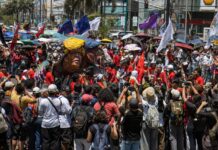
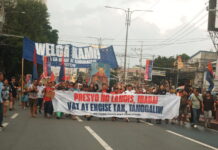
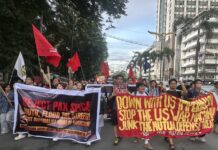
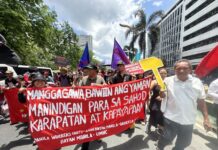






A week-long ecumenical prayer on the Week of Prayer for Christian Unity (WPCU) 2020 ended on January 25, 2020 at the Roman Catholic Church Cathedral of the Good Shepherd, Diocese of Novaliches. It was a great experience with “unusual kindness” because Christians from different perspectives, traditions and practices gathered for a common prayer.
Background of the theme of WPCU 2020
 The theme, “they showed us unusual kindness” is lifted up from Acts 28:2, which was an experience of Paul and companions both prisoners and soldiers. It was a story of surviving from the storm and shipwreck. The story is very interesting because Paul, a prisoner, spoke with precise judgments as he knew the about the situation of the sea and wind. By his faith and actions, he conveyed the grace of God to the people of Malta.
It must be recalled that Paul was imprisoned because of his preaching and witnessing of the “known” God.
Looking back on the ecumenism in the Philippines
Ecumenism is the principle or aim of promoting unity among the Christian Churches. In the Philippines ecumenism started in 1960s, though the World Council of Churches was founded in 1948 and the Roman Catholic Church has already considering the Christian Unity in the 1950. The National Council of Churches the Philippines (NCCP) was formed in 1963. Before the NCCP, the Student Christian Movement of the Philippines (SCMP) was founded on December 27, 1960.
The 57 delegates representing 52 SCMP chapters all over the country were committed to the national democratic ecumenical mass organisation of the youth and students. While it upholds the students’ democratic rights and welfare, SCMP integrates and actively participates in the Filipino people’s struggle for national freedom, democracy and human rights. It currently has twenty-five chapters with 800 members nationwide.
The NCCP’s forerunners include the Philippine Federation of Christian Churches in 1949; the Philippine Federation of Evangelical Churches in 1939; and, the National Christian Council in 1929.
At present, the members of NCCP are:
- Apostolic Catholic Church (ACC)
- Convention of Philippine Baptist Churches (CPBC)
- Episcopal Church in the Philippines (ECP)
- Iglesia Evangelica Metodista en las Islas Filipinas (IEMELIF)
- Iglesia Filipina Independiente (IFI)
- Iglesia Unida Ekyumenikal (IUE)
- Lutheran Church in the Philippines (LCP)
- The Salvation Army (TSA)
- United Church of Christ in the Philippines (UCCP)
- United Methodist Church of the Philippines (UMC)
The associate members of NCCP, which every organization has a representative in NCCP convention without the right to vote, are:
- Association of Christian Schools, Colleges and Universities (ACSCU)
- Consortium of Christian Organizations in Rurban Development (CONCORD)
- Ecumenical Church Loan Fund, Inc. (ECLOP)
- Kaisahang Buhay Foundation (KBF)
- Manila Community Services, Inc. (MCSI)
- Lingap Pangkabataan, Inc. (LPI)
- Philippine Bible Society (PBS)
- Student Christian Movement of the Philippines (SCMP)
- Union Church of Manila (UCM)
There was an aboveground ecumenical organization of church people which was founded before martial law, the Christians for National Liberation (CNL), but now exists underground.
The Christians for National Liberation (CNL) was founded at the worship room of the Sampaloc University Center in Manila on February 17, 1972, on the anniversary of the martyrdom of Fathers Gomez, Burgos and Zamora. Seventy-two revolutionary disciples of Christ gathered to bear the “cross of sacrifice” and raise the “red banner of revolution”.
They described themselves as a revolutionary organization of church people who had been challenged by social realities and their Christian faith to take part in the new democratic revolution under the leadership of the Communist Party of the Philippines and in accordance with the Program for a People’s Democratic Revolution. They adopted the battle cry, “Love your neighbor. Serve the people.”
In 1980s, there were ecumenical organizations being formed such as the Ecumenical Seminarians Fellowship (ESF) which served as organizer of the National Ecumenical Union Seminarians (NEUS). The Promotion of Church People Rights and the National Ecumenical Forum for Church Response (NEFCR), now these were consolidated into Promotion of Church People’s Response (PCPR) and the Ecumenical Bishops Forum (EBF). There were regional ecumenical organizations like KRUS in Metro Manila, RECENT and other formations throughout the country.
In 2011, in the Philippines, the Week of Prayer for Christian Unity (WPCU) started with the collaboration of the NCCP and the Episcopal Commission on Ecumenical Affairs (ECEA) of the Catholic Bishops Conference of the Philippines (CBCP). This ecumenical prayer is sustained until now and even the regional ecumenical bodies joint in the celebrations by holding their ecumenical prayers.
As of now, aside from the EBF, there is the Philippine Ecumenical Peace Platform (PEPP) which is an ecumenical formation that advocates the resumption of the Peace Talks between the Philippine Government (GRP) and the National Democratic Front of the Philippines (NDFP). The Philippine Council of Evangelical Churches (PCEC) is a member of PEPP.
The PCPR is still advocating a genuine national independence and democratic rights of the people in the Philippines.
The Quezon City Ecumenical Fellowship (QCEF) is working with the CBCP-ECEA and some church-members of the NCCP. QCEF is sponsoring theological fora and medical missions.
After the Ecumenical Celebration of the 500 years of the Reformation in November 2017, the Anawim Misyon para sa Mahihrap, Inc. was founded on April 7, 2018. The significant of this ecumenical group is the participation of the bishops, pastors and lay leaders of the Philippine Council of Evangelical Churches (PCEC). There is an Isaiah Ministry which was formed in August 2018 by Metro Manila-based church people.
In responding to the 2020 Year of Ecumenism, Inter-Religious Dialogue and of the Indigenous Peoples on October 22, 2019 an ecumenical forum was held through the effort of QCEF. The Ecumenical Initiative Forum (EIF) was formed after that ecumenical forum. The PCEC is being represented in this formation.
The task now: to sustain and strengthen ecumenism
Although the other formations should be strengthened and sustained in their own ways and efforts, the EIF should be given an utmost attention. As a new ecumenical formation which include the PCEC, the EIF can start from the basics of ecumenism.
The EIF can sponsor some discussions about the Churches in the Philippines, History of Ecumenical Movement in the Philippines and Prospects for Stronger Unity and Cooperation through Ecumenism.
The EIF can continue in holding theological fora and discussions on matters of faiths, missions and ministries.
The EIF can encourage Philippine Churches to organize regional, provincial and city ecumenical chapters.
The EIF can also support and encourage Philippine Churches in peace advocacy and promotion of human rights and social issues that are concerned of the people.
The EIF shall hold regular ecumenical prayers, social actions and meetings.


 2020 ended on January 25, 2020)