

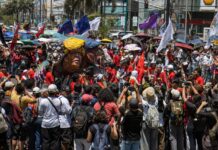
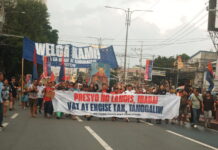
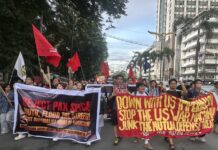
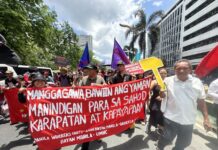







On February 26, the Senate voted 19-2 and approved on third and final reading the measure the consolidated measures to amend and effectively repeal Human Security Act (HSA) of 2007, what proponents of the amendments call a ‘weak law against terrorism’, and replace it with the Anti-Terrorism Act of 2020.
The amendment bill to the HSA seeks to impose more stringent penalties against those who “propose, incite, conspire, or participate in the planning, training, preparation, and facilitation” of a so-called “terrorist” act as well as those who finance or provide material support to “terrorists” and recruit members to a “terrorist” group. The law was signed 13 years ago under the presidency of Gloria Arroyo.
Posting in his website on the same day of the vote, Senator Francis ‘Kiko’ Pangilinan explained his ‘no’ vote to Senate Bill 1083:
“[This] representation fears that the amendments to the Human Security Act right before us may be abused as it will, among others, allow law enforcers or military personnel to place individuals and organizations under surveillance; compel telcos to divulge their calls and messages; arrest these people without warrant; and detain them for an extended period of 14 days.
The measure also allows regional trial courts to outlaw an organization as terrorist at the requests of even foreign and supra-national jurisdictions. It likewise removes the compensation for persons wrongfully detained.
And at a time when legitimate critics and democratic dissent are being attacked, the Human Security Act could be likened to a certain extent the anti-subversion law during martial law, and may be used against critics and opposition leaders.
Certain questions now come to mind: Can the law be used against democratic opposition leaders? Can opposition political parties be outlawed and tagged as terrorist organizations? Some may say this is farfetched and most certainly some will say this is not the intent of the law.”
Pangilinan recalled the case of opposition leader Senator Jovito Salonga. Salonga’s experiences during martial law included, after being implicated in the Plaza Miranda bombings, being (1) served an arrest, search, and seizure orders that did not specify the charges or charge against him, (2) denied visit from his lawyer, (3) transferred, against his objections, to an isolation room without windows in an army prison camp at Fort Bonifacio, (4) released from military custody and placed under house arrest “still without the benefit of any investigation or charges” and (5) charged with charges for subversion, among others, only after four months of detention.
Supreme Court records in the case of Salonga vs Cruz Paño cited, among other things, that (1) “Guilt by visit or guilt by association” theory is too tenuous a basis to conclude that Senator Salonga was a leader or mastermind of the bombings and (2) Salonga was indicted simply because some plottersm masquerading as visitors have somehow met in his house.”
The experiences of Salonga, Pangilinan said, “reinforce the well-founded fear of opposition leaders today of being persecuted under the Human Security Act. Given the current authoritarian climate, we face a well-grounded fear that it may be repeated.”
“The litany of lies and fabrications by the prosecution in that case revealed the extent of abuse of law enforcers inflicted upon an ailing opposition leader and former senator,” said Pangilinan.
Pangilinan said Ferdinand Marcos, Sr.’s justification for martial law then it as response to the “communist threat” and the sectarian “rebellion” of the Mindanao Independence Movement is similar to what is happening today that “are more than simply déjà vu, they are more like foreboding.”
“Our fear with an Administration that has jailed an incumbent senator on a case whose key witnesses are convicted drugs lords, that has repeatedly warned about imposing martial law all over the country, that has in fact imposed martial law in Mindanao under what we continue to believe to be questionable constitutional grounds.”
Pangilinan also hit the proposed new definition of terrorism as “vague and encompassing, making it open to abuse in that the simplest mobilization or common crimes can be framed by errant law enforcers as acts of terrorism.”
He also questioned the provision on the prolonged detention and said this is an impingement of rights and liberty.
“Why 14 days? If security officials and law enforcers are doing their job, why will it take them long to file a case? Or, is the practice of arrest and detain now, produce or invent evidence later still prevalent, as it was when opposition leader Jovy Salonga was arrested, detained, and charged in 1981?”
He said that while the law is not perfect and Congress should be working continuously to make it work for the people, “the amendments, however, are worrisome and could make the Human Security Act an even worse tool for repression, instead of an instrument for thwarting terrorists.”
In closing, he said laws should protect the people, protect the people from abuse and the wrong use of the law and that if the law is errantly implemented, somebody has to be accountable for the mistake not to happen again and so that the law will no longer be abused and so that ordinary people will not be mistreated. But if directed at ordinary people without power or influence and connections, the proposed law can be a terror to them.
“Without respect for rights, there can never be security.”
Senator Risa Hontiveros and Pangilinan both voted against the measure.


