

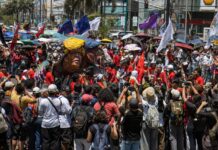
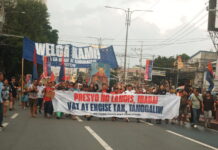
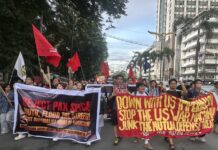
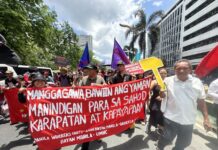








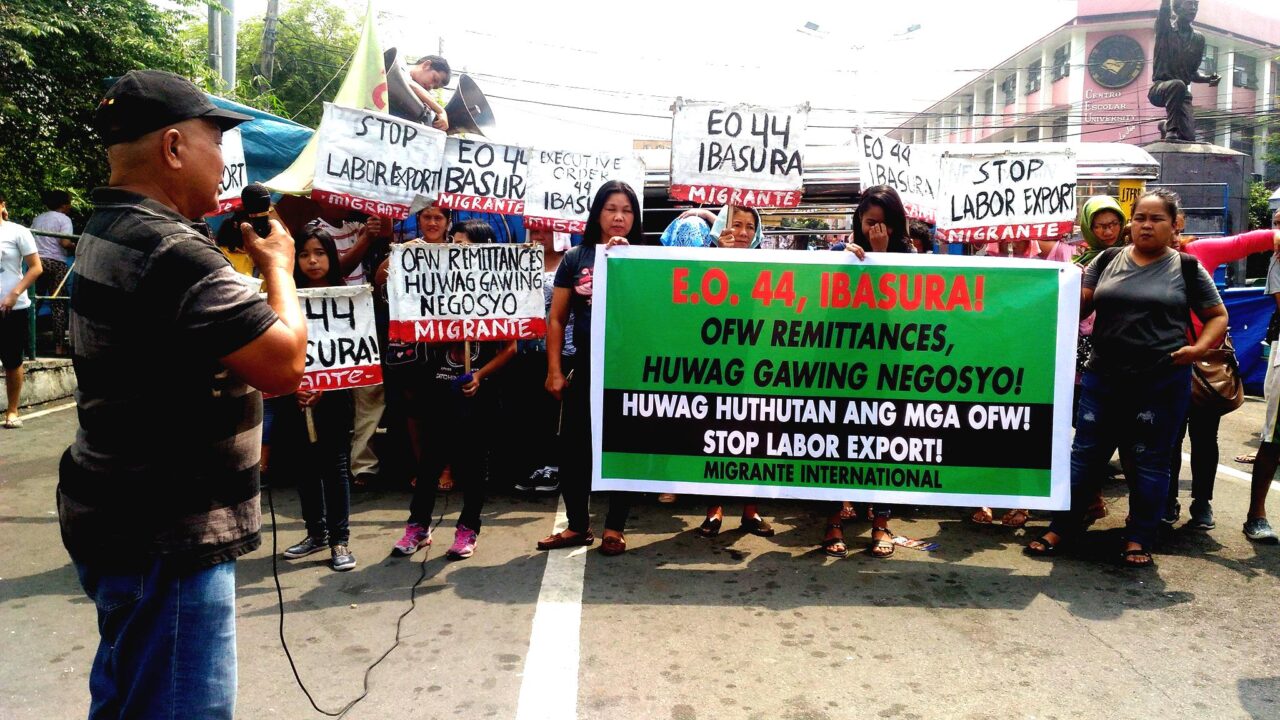
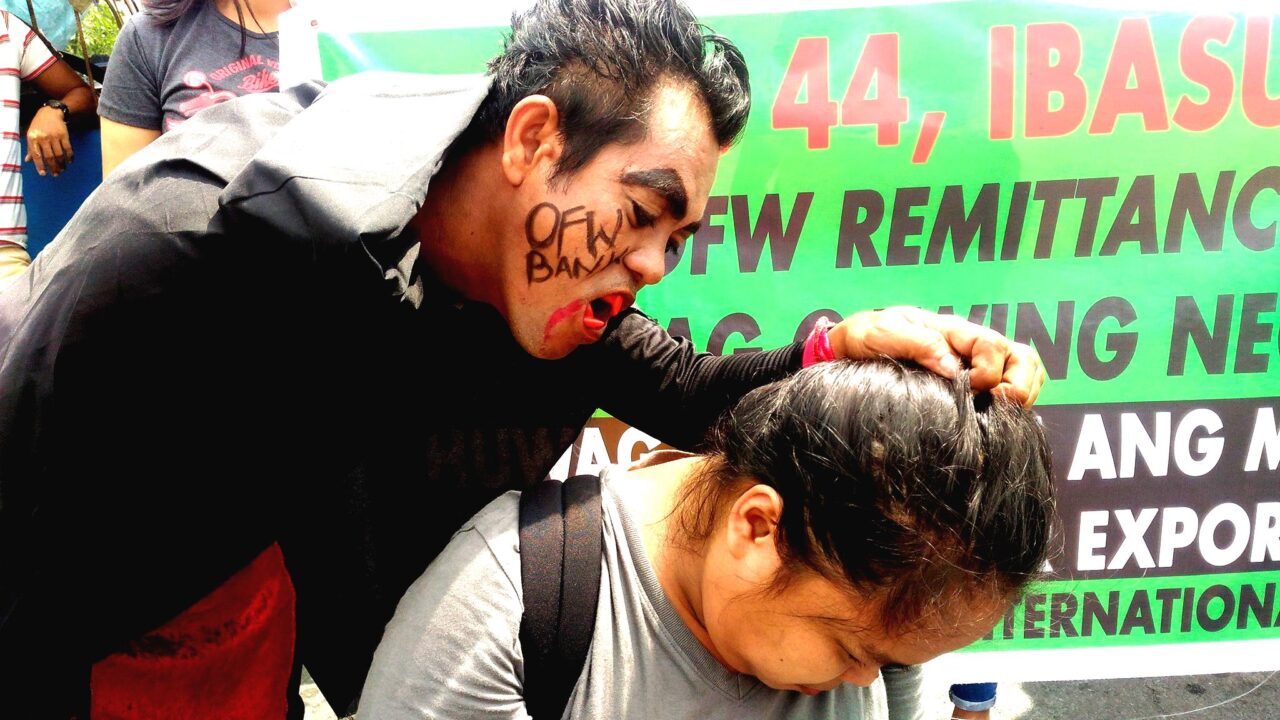
Overseas Filipino workers (OFW) group Migrante International held a Halloween-inspired protest rally in Mendiola today calling to stop President Rodrigo Duterte’s Executive Order (EO) 44, which will create the Overseas Filipino Bank (OFB). With a protester clad in vampire costume, the group depicted the OFB and the EO44 as a tool that would suck the blood out of Filipino migrant workers.
Migrante International saw the establishment of the OFB as a new money-making scheme of the government.
“The creation of the OFB does not in any way address the root causes of forced migration nor even attempt to curb it in the policy-level. Its key objective is to enable a more fast-tracked, sufficient and concentrated system of profiting from OFWs’ hard-earned incomes,” says Arman Hernando, Migrante International spokesperson.
EO 44 stated the transfer of shares of the Philippine Postal Savings Bank (PPSB) to the Land Bank of the Philippines for its subsequent conversion into the OFB. The purpose was to address “the need to establish a policy bank dedicated to provide financial products and services tailored to the requirements of OFWs, and focused on delivering quality and efficient foreign remittance services.”
The millions of OFWs, at present, avail of various bank and non bank transfer services to send personal remittances. OFW remittances in May reached $2.31 billion, a 5.5 percent year-on year increase, according to data from the Bangko Sentral ng Pilipinas. OFW remittances accounted for 9.8 percent of the gross domestic product in 2016.
Redundancy
In an interview, Hernando said that the OFB is only a duplication of the functions and services being implemented by existing government agencies for OFWs concerns like the Overseas Workers Welfare Administration (OWWA). Existing OWWA programs such as the OFW microfinance and microinsurance premiums would only be replicated by the OFB.
Hernando explained, “Encouraging OFWs to embark on ‘microfinancing’ will only bury them in greater debt to big banks and financial institutions, this time facilitated by the State itself.”
He added, “Meanwhile, enticing investments for so-called ‘microinsurance’ may only be deemed as yet another state exaction scheme in which OFWs are encouraged to allot their earnings to premiums and contributions that will ultimately be useless to them.”
Institutionalization of labor export program
“[The OFW bank] in itself further institutionalizes decades-long labor export program that continues to exploit OFWs’ cheap labor and remittances in accordance to neoliberal policies and dictates,” said Hernando.
Instead of fulfilling this promise, Hernando said, “the OFB was created for managing OFW remittances for the perpetuation of a long bankrupt labor export program.”
Migrante International said that past administrations have been aggressive in crafting programs and services aimed at facilitating and encouraging forced migration and have unfailingly and resolutely promoted the labor export program as unequivocally beneficial to OFWs and their families.
According to them, “this is what the Duterte regime hopes to achieve anew through the creation of the OFB, to the detriment of our OFWs.”
The group decried that this is a turnaround from the Duterte administration promise to create jobs in the country so that OFWs may go home and be able to work and live prosperously in their motherland. Duterte was also unequivocal on the promise to end contractualization in a year, but this has not been accomplished. Poor wages and work conditions have pushed millions of Filipinos to work abroad in nearly half a century.
The group also thought the promise of providing productive jobs at home would have been possibly fulfilled when the peace talks of the Philippine government with the National Democratic Front of the Philippines was revived. The substantive agenda on the negotiating table was social and economic reforms, with agrarian reform and national industrialization as its main topics. But Duterte cancelled the fifth round of peace talks in May and have since went on a flowing tirade against the revolutionary group and even protests of various poor sectors.
Migrante International said that in order to address the problem of forced migration, the government’s economic policies should focus on developing national economy by advancing local industries, agriculture and basic services.
“Only then can OFWs look forward to a future where they will not have to leave their families behind just to survive,” Hernando ended.


