

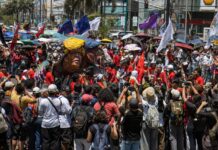
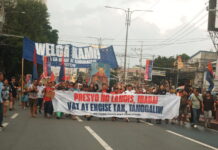
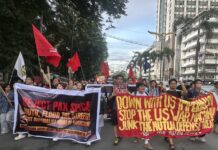
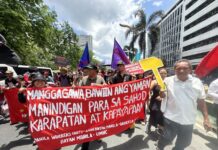



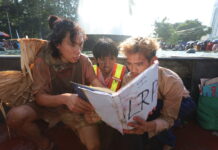

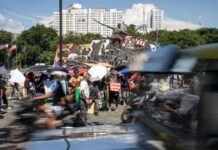
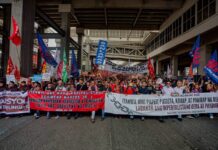


Mobilizations have intensified across different areas in Metro Manila to demand accountability and condemn the questionable and anomalous flood control projects under the Marcos Jr. administration.


In Quezon City, Kyusi for Truth and Accountability (K4TA) held a protest along G. Araneta Ave. near Brgy. Tatalon to register their grievances against the flood control projects under the Department of Public Works and Highways (DPWH).

K4TA lead convener Lorevie Caalaman highlighted the findings of the Quezon City Local Government Unit (LGU) investigation, which reported that only two out of 254 DPWH flood control projects had been approved by the LGU.
“Despite being highly funded, these projects lack the standards to mitigate flooding in Quezon City. In fact, one project even collapsed in Barangay North Fairview near the Tullahan River last August 29,” said Caalaman.
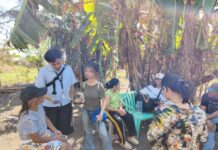
K4TA also visited one project site under the Metro Manila Flood Management Project Phase I in Brgy. Doña Imelda, adjacent to Brgy. Tatalon.

E.F. Chua Construction Inc. is the project contractor with a total funding of P568.90 million through the International Bank for Reconstruction and Development (IBRD) and the Asian Infrastructure Investment Bank.
Right-of-way
Last January, Manila Today also visited the site and interviewed nearby residents in the Brgy. Doña Imelda pumping station who raised concerns about the right-of-way.
In 2022, various residents in the area have already been displaced due to the construction of sheet piles to rehabilitate the San Juan River. Over 278 families had been relocated to various parts of Bulacan, while others were moved to a tenement in Brgy. Holy Spirit, Quezon City. Some residents, however, refused to leave.

One resident, who was offered relocation in Brgy. Holy Spirit, said the site is not even livable following issues with water and electricity. 23 families have since been relocated to the said area.
“For seven years, wala pa ring sariling linya ng tubig at kuryente doon. Malayo rin yung lugar sa eskwelahan ng mga bata at sa trabaho. Kung meron mang sariling kuntador ay dahil may mga kamag-anak o kaibigan na pinapakisuyuan na kabitan sila,” the resident shared.

Currently, the resident earns a living by selling bottles of cooking oil. She collects them from scavengers, cleans them, and resells them at P260 to P280 per dozen.
However, she explained that this modest livelihood cannot be sustained if she is forced to relocate.
“So yung ganyan kapag ganitong trabaho, kapag narelocate hindi ko naman madadala roon gawa ng nasa 4th floor ng building yung bahay ko,” the resident shared.

Since the construction of the pumping station in Brgy. Doña Imelda, their houses have already been marked with sheet piles, indicating the boundary line for the project.
These sheet piles serve as markers showing that their homes fall within the supposed right-of-way while the pumping station is being built. Now, residents are appealing for possible adjustments, arguing that their houses do not actually obstruct the project.
“Kung meron man kaming gustong irekwes, yung i-adjust yung right-of-way namin. Nakikita ninyo naman, nakakadaan naman sila, may dalawang backhoe na riyan. Kung posible naman pala, edi i-adjust nila para bigyan kami ng daan,” the resident explained.
Flood control projects in NCR
E.F. Chua Construction Inc. is one of the top contractors, having secured at least 20 flood control projects amounting to P1.5 billion since 2022.
Out of 4241 flood control projects in the Philippines, 1057 are in Metro Manila with a total cost of P52.5 billion, according to DPWH.
Quezon City ranks second in Metro Manila with 141 flood control projects worth P5.3 billion. Meanwhile, Manila City ranks first with 215 flood control projects amounting to P14.5 billion.
Eight J’s Construction Services had the most projects, securing 37 flood control projects amounting to P3.2 billion. The said company is also one of the contractors behind a high-value single project in Metro Manila.

Meanwhile, Caalaman noted that E.F. Chua Construction Inc., owned by Gerald Chua, has already appeared in various controversies.
In 2019, E.F. Chua Construction Inc. was involved in a violent demolition in Sitio Malipay, Molino IV, Cavite. A security guard was stabbed to death while five others were injured during the clearing operation that displaced around 2,000 families.
In 2024, residents filed a complaint before the Municipal Trial Court in Cities Branch 1 in Bacoor City.
The said complaint stemmed from acts of dispossession committed by the E.F. Chua Construction in connection with a DPWH project that began in June 2022. Residents stressed that the construction company destroyed plants, trees, fences, and carried out deep excavations in and around their land, leaving their homes practically uninhabitable.
Beyond infrastructure projects, Chua was also linked to the “flying voters” case in Makati City in 2023. According to reports, Chua sent lawyers from the Quasha law firm to represent the alleged bogus registrants.
In a court ruling dated August 24, 2023, Makati RTC Branch 142 Judge Rainald Paggao noted that the court summons issued to the registrants were personally received by Chua at his residence, which happened to be the same address listed for several of the questionable voters.
“Such a law firm is de campanilla and certainly does not come cheap,” the judge remarked, adding that this was “not an idle thought that there is something more than meets the eye.”
Meanwhile, the said project in Brgy. Doña Imelda is not included in the accessible data under DPWH.
In 2017, the Philippines borrowed $415.2 million from the World Bank (WB) to fund the Metro Manila Flood Management Project Phase I. Only in September 2024, a restructured report from WB showed a reduction in project cost to $368 million.
The construction of the said pumping station began in September 2024 and is expected to be completed by September 2026.
“As part of the campaign to continuously raise awareness and participation against corruption, K4TA vowed to launch a series of mobilizations, culminating on September 21. Every centavo that was used for these projects had been paid by the Filipino people. This money could have also been allocated to other social services that currently lack adequate funding. Without accountability, our democratic rights as Filipino citizens are being trampled,” said Caalaman.
Access to the full dataset is provided through this link.


