








The Philippine Children’s Medical Center (PCMC) in Quezon City was finally granted its land ownership title after a memorandum of agreement (MOA) was signed between PCMC, Department of Health (DOH) and National Housing Authority (NHA) on Feb. 5, 2015. The signing of the MOA ended the three decades of struggle for PCMC’s permanent occupancy of the 3.7-hectare lot.

In September 2014, the public hospital located along Agham Road and Quezon Avenue Extension in Quezon City was given an eviction notice by the NHA. The NHA, owner of the lot the PCMC occupies, demanded the PCMC to pay for the lot at a price of P1.1 billion or else the hospital will be evicted and transferred to the compound of the Lung Center of the Philippines (LCP). The money, as justified by NHA, would be used to raise revenue for its housing projects and relocation of informal-settler families.
Since then, the administrators, doctors, employees and patients of the hospital called on the NHA and the administration of President Benigno Aquino III (PNoy) to donate the land to PCMC. The NHA is a government-owned and controlled corporation (GOCC) under the Office of the President, while the PCMC is a GOCC under the DOH. The DOH, meanwhile, is under the executive department. All three involved government offices are under the Office of the President.
According to PCMC deputy director for hospital services, Jara Corazon Ehera, the support of various sectors was a huge help in pressuring the national government to donate the land to the children’s hospital. Organizations like Gabriela Women’s Party, Akap Bata, KADAMAY as well as Makabayan Coalition in the House of Representatives and the private sector lobbied to the national government for the land to be granted to the PCMC.
“’Talagang (nakatulong ‘yung) multi-sectoral support na nag-call sa national government na aksyunan na ‘yung problema ng PCMC. High time na kasi tignan ‘yung problema. [The multi-sectoral support really helped in calling for the national government to act on the problem of PCMC. It was high time to address the problem],” said Ehera.

The triumph of the PCMC to secure its land title was lauded by Gabriela Women’s Party Representative Emmi De Jesus. De Jesus, together with Representative Luzviminda Ilagan, filed a House Resolution urging PNoy for an immediate finalization of PCMC’s land acquisition.
“Saludo ang Gabriela sa tatag ng mga stakeholders ng PCMC na labanan ang programang pribatisasyon ng gobyernong Aquino, para ipagtanggol ang karapatan ng mahihirap na kabataan sa libreng serbisyong medikal. Nararapat lamang na ibigay na sa PCMC ang lupang kinalalagyan nito at lalo pa nitong palaguin ang mga programang nakatutok sa ating maralitang pamilya [Gabriela salutes the will of the stakeholders of PCMC to fight against the privatization pushed by the Aquino government, and to fight for the rights of the poor children for free medical services. It is just rightful to give the PCMC the land it occupies, and for it to further improve its programs for urban poor families],” said De Jesus.
Senate hearings
Senate hearings were held in November and December last year to address the issue of PCMC. Ehera pointed out a 1992 document showing a property swap agreement between DOH and NHA, wherein a 5.7-hectare DOH property in Cebu City will be given to NHA in exchange of the hospital’s land.
Meanwhile, another document made in 2003 showed that the Cebu property title was already transferred in favor of the NHA, proving that the agreement was already executed. Department of Justice (DOJ) then affirmed the ownership of DOH of the PCMC property.
“Bakit hindi pinaalam sa amin ng NHA na nasa kanila na ‘yung lupa (sa Cebu)? Bakit ‘di pa binigay ‘yung lote (ng PCMC) sa amin? [How come NHA did not inform us that they have already acquired ownership of [Cebu] property? Why did they not give us the PCMC lot?]” said Ehera.
Based on the appraisal of the Bureau of Internal Revenue, the PCMC lot costs a lot more than the Cebu property, amounting to P1.395 billion and P452 million respectively. This results to a net amount of P942 million difference that the NHA is asking the PCMC to pay.
The P942 million will be collected from the budget of DOH and will be paid in two tranches: P500 million for the first installment in 2015 while the remaining P442 million will be given in 2016.
Meanwhile, the House of Representatives inserted a P1.2 billion budget allocation for the PCMC in the 2015 National Budget, P500 million of which will be turned over to the NHA as the first tranche, while the remaining P700 million will be used for improvements in the hospital.
Privatization to eviction blues
The PCMC, established 35 years ago, accommodates 60,000 patients yearly, mostly coming from poor families. Considered as the country’s biggest public hospital and “DOH’s flagship hospital for children”, it specializes on severe and complex diseases like cancer and leukemia, and has helped poor families to afford expensive medications.
In 1986, PCMC was turned into a government-owned-and-controlled corporation (GOCC). Becoming a GOCC, the PCMC is forced to conduct income-generating activities to earn its own keep, despite still being given a reduced subsidy from the government. This led to medical services fees being raised in all specialty public hospitals-turned-GOCCs in the vicinity: the LCP, National Kidney and Transplant Institute (NKTI), and Philippine Heart Center (PHC). The GOCC character of these public hospitals also allowed for commercial and non-commercial activities to coincide despite their public character. Thus, different kinds of businesses, such as privately-run canteens and food concessionaires, operate inside the grounds of the hospitals. This also led to the privatization of some facilities and procedures, like blood sugar analysis and hemodialysis.
A shrinking budget for public healthcare in general was observed by the Alliance of Health Workers. According to them, the allotment of budget for government hospitals has been reduced from 39% in 2009 to 21% in 2014, based on the total DOH budget. On the other hand, despite getting the largest subsidy among the specialty hospitals, PCMC only received a subsidy of 26 million in October 2014, compared to P43 million it received in February 2014.
Meanwhile, since 2002, the national government has started the planning and implementation of the Quezon City Central Business District (QC-CBD), threatening the existence of structures along major roads perpendicular to the Elliptical Road, almost all of which are government properties. Among the affected health institutions are the PCMC, NKTI, PHC and LCP.

Work on the QC-CBD has started in the Agham Road area, just across PCMC, where the 29-hectare San Roque village occupied by more than 5,000 urban poor families was demolished since September 23, 2010, a few months after PNoy took office. The only seedling bank in the metropolis was also demolished in 2014, amid protests of various environmental groups, to give way to construction of buildings that are part of the QC-CBD.
Also known as the Triangle Park, it will cover more than 250 hectares land along EDSA corner North Avenue, mostly for commercial use. The Ayala Corporation has already invested P65 billion for the 30-hectare Vertis North, where condominiums such as Avida Towers Vita and Alveo High Park Vertis will rise. These structures will stand beside the Ayala mall, Trinoma.
Before PCMC was granted its land title, it was being pushed to relocate to the compound of LCP where a high-rise building will be constructed to house the hospital. However, it was opposed by the administration of PCMC, saying that it will only disrupt the hospital’s operations. Aside from this, they said that a high-rise building is not also advisable as it would be difficult for sick children to evacuate in times of emergency. The proposed high-rise building will also be smaller than the current facility of the PCMC, which only meant that they would also be made to cater to fewer patients, according to Ehera.
Ehera said that the MOA signing has been a huge relief for the patients and staff of the hospital after decades of uncertainty.
“Before that (MOA signing) palaging ang mga pasyente namin, may agam-agam. Nagwo-worry din ‘yung mga empleyado sa seguridad ng trabaho if ma-relocate ‘yung ospital [Before the MOA signing, our patients always had worries. Our employees were also worried with their job security if ever the hospital will be relocated],” said Ehera.
#SavePCMC
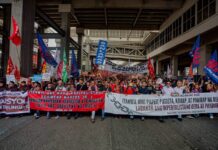
In June 2014, an alliance opposing the eviction of PCMC called #SavePCMC was launched by employees of PCMC and various organizations, such as Akap Bata, Salinlahi Alliance for Children’s Concerns, Kadamay, and Network Oppose to Privatization among others. From then on, different forms of protest actions were initiated, including an online petition on Change.org.
Ana Saplor, Secretary General of advocacy group Akap Bata, stressed the unity and action of the staff of the hospital and various organizations that pressured the national government and NHA to grant the land to the PCMC.
“Talagang sila ay organisado, konsolidado, at nagkaisa dun sa panawagan na ibigay ‘yung titulo ng lupa. [They were organized, consolidated, and united in their call for the land title to be given to them.],” said Saplor.
The PCMC staff engaged in protest actions such as noise barrage and picket protests in front of the NHA. In June 2014, hundreds of doctors, nurses and staff of the hospital held a flash mob to the beat of Michael Jackson’s “They don’t care about us” to express their opposition to the government decision to evict the children’s hospital.

Saplor also pointed out that this happened during a time when the Disbursement Acceleration Program and pork barrel scandal were heated issues.
“Last year pumutok yung isyu ng pork barrel, ang tanong bakit hindi magawang bayaran ng gobyerno yung lupang kinatitirikan ng PCMC, pero ang daming nakokorap na pera galing sa pondo ng bayan, budget para sa mamamayan [Last year when the issue of pork barrel came out, the question was why don’t the government pay for the land the PCMC occupies, when billions of pesos were easily corrupted from the national budget, the budget for the people],” said Saplor.
If the land was not granted to the PCMC, the facility was supposed to be replaced by a high-rise building by a still un-named developer. Because of this, Saplor said that they will remain vigilant despite the PCMC’s initial triumph in the land title, especially with the bigger issue of privatization faced by public hospitals in the country.
PCMC deputy director Ehera also said that a perennial problem in children’s public hospital is its limited resources, given the high maintenance and operation costs for their hospital.
“Isa sa mga (nananatiling) isyu ay ‘yung budget allocation pa rin, resources ay limited. Patuloy naming ipinaglalaban ‘yun para sa continuing developing facilities, global quality health care, enhancement para sa mga bata, and it requires a lot of support [One of the standing issues is the budget allocation; our resources are limited. We continue to fight for this to provide for the continuing development of our facilities, global quality health care, enhancement for the children, and it requires a lot of support],” said Ehera.


