

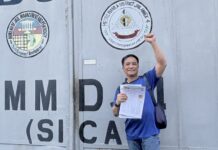









“I worked there for almost two years…With regard sa sinasabing bases, for my experience wala po akong nakita,” said Darwin Dela Cruz from Doctors Without Borders/Médecins Sans Frontières (MSF).
[I worked there for almost two years…Regarding the mentioned bases, from my experience, I didn’t see anything like that.]
He said that in response to Israel’s accusation of hospitals being controlled by Hamas.
Dela Cruz was among the repatriated Filipino healthcare workers from the Gaza Strip. As a medical coordinator for MSF, his primary concern focused on supporting hospitals and being a liaison to the Ministry of Health (MH) and other international NGOs. He is also responsible for overseeing medical activities that are properly executed for patients in need of immediate help.
As a registered nurse and midwife, Dela Cruz had been in Gaza and experienced two escalations: one in August 2022 which lasted for three days and in May this year which lasted for five days.
“When the Talibans took over the country in Afghanistan, I thought that was the pinakagrabeng digmaan [most intense war] that I experienced. In Afghanistan, the Taliban is against the government soldiers. Dito [Here/Palestine] they [Israel] are just bombing everywhere, everyone,” Dela Cruz added.
Roof knocking, a warning prior to bombing shelters
“Before the war, the Israeli are doing roof knocking method whereby magda-drop sila ng leaflet [they will drop leaflets] sa building if they want to target it. They will inform the occupants, it depends, sometimes 10 minutes, 20 minutes, 30 minutes to 1 hour because they will bomb it,” Dela Cruz shared.
In some instances, the Israel Defense Force (IDF) military would inform a person from the building to spread the news of immediately evacuating the area—sometimes only 10 minutes before destroying the building.
“That was before this war, but this war wala nang sinasabi basta bomba nalang nang bomba,” he added.
[That was before this war, but in this war, there’s no more warnings, just continuous bombings.]
The United Nations has reported that roof-knocking, while intending to warn Palestinians before targeting buildings, has often failed due to factors from no one hearing the knock given the noise of other bombings, inaccuracy on the target building locations, or residents being too old, sick, scared, or unwilling to evacuate.
“Based on its findings, the commission concludes that the “roof-knocking” technique is not effective, in particular, if not combined with other specific warnings,” the UN said in its report.
Failing medical and social care for Palestine
Primary healthcare centers and hospitals in Gaza are predominantly run by the United Nations Relief and Work for Palestinian Refugees in the Middle East.
Three days after the attack, the MH sought medical assistance from MSF for the casualties of Israeli bombings. The support was utilized for only three days due to an overwhelming number of injured individuals. A week later, MSF further extended their support by donating their nine-month supply of medicines for all three sections in the Gaza Strip.
The said nine-month supply had been used up in just over a week.
Dela Cruz said that Gaza’s healthcare system was already on the brink of collapse, with a meagre number of 25 ICU beds available out of a total capacity of 3,450 hospital beds while serving a population of over 2.2 million Palestinians. In fact, he remembered that this shortage significantly contributed to the loss of lives, even during the COVID-19 pandemic.
“Noong COVID ay maraming namatay sa kanila because they cannot even [go] to a cheaper hospital na nangangailangan ng respirators. There are also no specialized treatments, cancer for example, and even diagnostic procedures because Israel imposed a dual-purpose use policy since 2005 whereby pieces of equipment na mayroong parts that can be used to manufacture weapons, like MRI for example, xrays, talagang hinihigpitan ang pagpasok sa Gaza,” the nurse explained.
[During COVID, many of them died because they could not afford to go to a more affordable hospital that needed respirators. There are also no specialized treatments, such as for cancer, and even diagnostic procedures because Israel has imposed a dual-purpose use policy since 2005. This policy tightens restrictions on the entry of equipment with parts that can be used to manufacture weapons, like MRI machines and X-rays, into Gaza.]
Israel imposed restrictions on the entry of numerous items to both the West Bank and Gaza under the Defense Export Control Law of 2007 and the Defense Export Control Order, where two “dual-use” item lists exist—one for the West Bank and Gaza, and another specific to Gaza, going beyond Wassenaar Arrangement agreements.
These lists include crucial construction materials and everyday civilian goods, with the Gaza list comprising items necessary for construction and various goods for civilian use.
Meanwhile, regarding medical use, Gaza only had one functioning MRI machine last year. That is just one to serve a population of 2.2 million to reiterate.
Dela Cruz shared that healthcare workers have long been lamenting the arduous process of obtaining permits for medical referrals to other regions often results in delays.
“Kapag mayroong mga cases na kailangan i-refer sa West Bank, Egypt or even sa Jerusalem, the MH will ask for a permit from the Israeli and that would take for ages, sometimes six months to one year. Sometimes ang pasyente, patay na,” he added.
[When there are cases that need to be referred to the West Bank, Egypt, or even Jerusalem, the medical hospital will request a permit from the Israelis, and that can take ages, sometimes six months to a year. Sometimes, the patient has already passed away by then.]
According to Dela Cruz, forty-seven out of 75 primary healthcare hospitals are totally damaged while there are 35 out of 46 hospitals that were no longer operational.
Medical doctors at stake
During escalation, Dela Cruz shared that some experts are not allowed to go to the hospitals or even roam around the streets except for their national colleagues who actually continue the work.
“We moved five times from our guest house. On the second day, they bombed the mosque in front of our guest house so the glasses and the doors were shattered. Maririnig at mararamdaman mo yung yanig, yung impact [You will hear and feel the tremor, the impact],” he recalled.
By the time the guest house was also declared unsafe, their team immediately transferred to the United Nations Development Programme (UNDP) compound which was the only building in Gaza that had an underground bunker.
Dela Cruz along with his team in MSF had to stay there for three nights and four days before transferring to Rafah. They added that the UNDP compound already sheltered more than 25,000 before they left.
In Rafah, he shared that this was the time it had been difficult for them to purchase essential items like food and water in the market.
“Maliban sa maraming namamatay because of bombs [Besides the many deaths caused by bombs], people also die because of hunger and dehydration. At some point, our drivers were the ones we sent to the market and sometimes mayroong strike malapit sa kanila. [they faced strikes near their location.] If not because of them we were probably dead,” Dela Cruz said.
For weeks, MSF managed to find a guest house in Al Mawasi area in Khan Yunis which was declared a humanitarian zone that sheltered all UN agencies and other international NGOs.
This was also the time when he and Regidor Esguerra, also a Filipino nurse, were picked up by local media—eventually leading them to be able to move out of Gaza.
“It is frustrating that we are far away and we cannot do anything. As of two days ago, we lost one lab technician and one driver to doctors and many are still wounded most of our staff and the people in Gaza have lost tens and tens of their immediate families. Most of them were killed,” Dela Cruz lamented.
The Israeli’s continuous bombings have killed more than 14,800 people in Gaza since October, with more than 33,000 injuries. There are many more people in the buildings that have not yet been recovered and are still in the rubble.
“If you will ask me kung babalik ba ako sa Gaza, yes,” Dela Cruz weepingly said while saying that Palestinians have become his family.
[If you ask me whether I will go back to Gaza, yes.]
“Even though my body is here, my spirit and my heart is in Gaza. Hindi ka ba natatakot sa sarili mo? [People ask, aren’t you afraid for yourself?] Well, that was the pledge I made 10 years ago when we experienced typhoon Haiyan. Wherever my expertise or wherever I’m needed, and this time it’s Gaza,” he added.


