

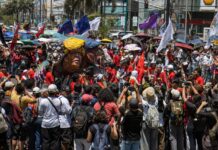
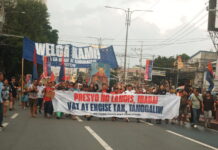
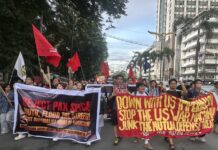
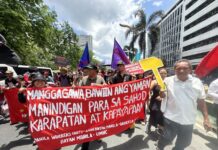








The nurses averaging around 10,000 in a year who plan to go abroad should not be deprived of their right to better livelihood or basic sustenance, said the Filipino Nurses United (FNU).
“The government’s decision to ban the deployment of nurses and other healthcare workers has no place in this scenario of health human resource inadequacy because there are minimum of 240,000 unemployed nurses or untapped nurses who can be maximized to be active in the health COVID-19 response,” said the FNU in a statement on August 24.
They also called on the government to fill up 13,000-vacant government health worker plantilla positions.
“Nurses in the country must be hired with guarantee of job security (not 3 months contract of service), minimum pay of P32,000 a month for all nurses, public and private sector, just and fair benefits, and guaranteed protection in the workplace,” said FNU.
The group said if the government would provide the aforementioned just salaries, compensation, benefits and protection to our frontline health workers including nurses, the emergency hiring of healthcare workers program would definitely attract more applicants.
“It is hurtful to our fellow nurses to question their patriotism for opting to work in other countries that can provide them the chance to provide food security, access to basic health and education needs of their families which they were not provided in this country after spending years of so-called volunteer work without pay and/or working for several years in government and private hospitals with very low monthly salary like P7,000 to P10,000 on the average,” said FNU.
However noble the government’s intent in the deployment ban, the group insisted it does not have the right “to prevent its citizens from employment that supports their basic survival.”
Why nurses are again calling for the ban to be lifted
The government has issued written orders and verbal statements for total deployment ban and for allowing those with contracts as of March 8, one after or over the other, which has caused alarm and anxiety among nurses and health workers who are looking forward to their overseas deployment.
The Philippine Overseas Employment Administration (POEA) issued Governing Board Resolution No. 09, series of 2020 on April 2, ordering the temporary suspension of the overseas deployment of “mission critical skills” such as medical doctor, nurse, microbiologist, molecular biologist, medical technologist, clinical analyst, nursing assistant/aid, pharmacist, laboratory technician, and x-ray/radiologic technician among others, until the national state of emergency is lifted or until COVID-19-related travel restrictions are lifted in their destination countries.
The Inter-Agency Task Force on Emerging Infectious Diseases (IATF) Resolution No. 23 allowed medical and allied health professionals with ‘perfected and signed employment overseas contracts as of March 8, 2020’ to proceed with their employment, making them the exception to POEA Governing Board Resolution No. 09, series of 2020.
But on August 14, the top Labor official issued a warning against the supposed deployment of nurses abroad.
“The public is hereby warned that any overseas deployment of nurses unless expressly authorized by the POEA is deemed illegal,” Labor Secretary Silvestre Bello III said in a statement,” said Department of Labor and Employment (DOLE) Secretary Silvestre Bello III, denying the government has eased restrictions on deploying nurses abroad.
The IATF Resolution No. 64 on August 17 upheld the health worker deployment ban, pursuant to POEA Governing Board Resolution No. 09, series of 2020.
Nurses pushing for the lifting of the deployment ban, including a group called Prisonurse, held a Twitter rally on August 19, using the hashtag #SetPhNursesFree.
Around 1k nurses with existing contracts overseas are affected by the deployment ban. But, the impact is even bigger. Each nurse represents a family of atleast 4, some even more. Imagine how many lives are at stake just because we are hostaged. #SetPHNursesFree
— prisoNurse_lexie (@lexiebarcelona) August 19, 2020
You have shut us down already for months for reasons regarding our safety. Now you’re shutting us again, this time for your own selfish reasons. We are not your property and we fight for what we know is right. #SetPHNursesFree
— Winona (@PrisoNurse_Winx) August 19, 2020
Do they think nurses will be encouraged to apply in PH gov’t hospitals when they already have perfected contracts and spent a fortune to process all their papers?!
PLEASE DON’T PROLONG THEIR AGONY.
Please help us to be heard, Sir @Joseph_Morong ?https://t.co/HcThlS2Jkg
— Nurse Hokage (@thenursehokage) August 18, 2020
Please don't stop us in pursuing our dream to give our family a better life. Wala naman na trabaho dito sa pinas eh. We have already served this country for 11 years, sapat na yun. #prisoNurse pic.twitter.com/yuTEK9OXR5
— Kristina Gamboa (@KristinaGamboa2) August 19, 2020
The POEA issued a clarification on the deployment ban on August 20, again allowing returning health workers and new hires with contracts signed as of March 8 to proceed to their overseas employment.
On August 21, DOLE Sec. Bello said around 600 to 900 registered nurses, who are exempted from the government’s overseas deployment ban on health workers, would be allowed to leave the country.
On August 25, nurses held another Twitter rally using the hashtag #JusticeForNurses.
No matter how much we speak. They never listen. The HCW ban is still there. They already acfepted the fact that there is a oversupply of nurses. They only need 3000 nurses there is a pool 200k+ nurses here in our country.
Prove your worth? We already did.#JusticeForNurses
— Jerrick Gomez (@GomezJerrick) August 25, 2020
Filipino nurses are seasoned nurses. We do not need forced servitude nor forced heroism to prove our clinical skills. We need the best compensation for simply having our compassion. #JusticeForNurses
— Nurse Anj (@nurse_anj) August 25, 2020
Yung wala kang masabi kundi luha nalang ??? #JusticeForNurses pic.twitter.com/X4nkMATNdt
— jay-ar (@jrsalicipan) August 25, 2020
Nurses top list of COVID-19 cases among health workers
The Department of Health (DOH) has recorded a total of 6,499 cases among health workers as of August 22. Nurses top the cases among health workers with 2,269 (35%). Of the 39 deaths among health workers, 6 were nurses.
FNU posed recommendations to safeguard nurses in the COVID-19 frontlines:
- There should be an observance of DOH standard nurse to patient ratio of 1:1 in ICUs, 1:3 in COVID-19 wards, 1:12 in regular non-COVID 19 wards and 1:6 in ERs.
- There should be mandatory routine RT-PCR tests every 14 days for nurses and 14-day quarantine.
The group also recommended benefits for nurses on top of the Magna Carta of Public Health Workers benefits:
- P500/every 8 hours work per day COVID-19 hazard pay during pandemic (not only during enhanced community quarantine or ECQ)
- monthly special risk allowance of 25% of basic pay
- P100k compensation in case of infirmity due to COVID-19 regardless of severity and P1M in case of death while in line of duty (regardless of COVID-19 test result)
In the case of nurse Maria Theresa Cruz whose story went viral due to her daughter’s revelation of having received only P7,265 hazard pay after her mother’s passing, amounting to only around P60.93 additional hazard pay per day of service during the COVID-19 pandemic.
Malacañang Palace’s Administrative Order 26 signed on March 23 mandated P500 per day hazard pay for employees of national government agencies, including state colleges and universities, and government-owned and controlled corporations who report during the quarantine period. Those who are already receiving hazard pay shall continue to be entitled to such benefits or the COVID-19 hazard pay, whichever is higher.
FNU found the phrasing in the order have made P500 the limit, with too little that could be added as COVID-19 hazard pay as in the case of Cruz, and despite nurses working more than 8 hours a day.
For the private sector, FNU asked for hazard pay in addition to the regular hazard pay. The group asked that the IATF and DOLE should mandate private health facilities to provide hazard pay of 25% of basic pay through a written order.
FNU noted there are still many job order and contract of service nurses who have not received hazard pay for months, and there are those being asked to return their hazard pay after ECQ.


