








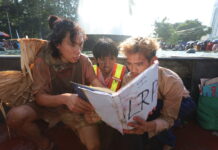






In the first chapter of his book Memories of Silence, Thongchai Winichakul, a Thai historian, outlines his thrust for remembering and forgetting of historical happenings, particularly the massacre of October 1976: Silence is not an act of forgetting. It marks the struggle to either recall or release the past, the difficulty of shaping memories into meaning, or escaping them altogether. He called it the “unforgetting,” which is the in-between state of neither remembering nor forgetting.
Opening this review with Winichakul’s book will become meaningful as this review progresses, since much of Ratchapoom Boonbunchachoke’s work engages with the same project of unforgetting. Like their 2020 short Red Aninsri, the film strategically manipulates shifts in voice to reveal the corruption and inherent contradictions within the law, while also revealing the ways in which such vocal transformations shape modes of self-expression and inform one’s interpretation of history.
In Boonbunchachoke’s debut feature-length film, A Useful Ghost (2025). First premiered at the 2025 Cannes Film Festival, Critics’ Week section, where it won a Grand Prix. Followed by its local theatrical release, it was brought to the Philippines through the 13th QCinema International Film Festival under the Asian Next Wave programme. The film also won Best Picture and Best Production Design for Rasiguet Sookkarn from the festival.
The film underscores the tension between historical memory and contemporary development from its opening scene: it draws from the mural, creating an imagery associated with the People’s Party of the 1930s. This motif later gives way to a depiction of transformation, marked by the construction of a luxurious mall with the tagline “the future is now” on the very site where the mural once stood.
In the following scenes, an important object is reintroduced into the narrative, one that will serve as a narrative device: the vacuum. Because of the dust from ongoing construction, the academic katoey (Wisarut Homhuan) bought one to solve the problem. However, due to the strange things happening that seem to come from the vacuum, this drives them to investigate what unusual events are occurring. In these moments, as the strangeness of the first few minutes of the film fades, we are now being pulled towards where the narrative will lead us: a queer way to revisit the history and irony of an ever-changing society.
With Krong’s (Wanlop Rungkumjad) appearance as the vacuum fixer, the narrative takes a complete turn, loosely based on the folk legend Mae Nak. By making sense of the problem, he leads the audience into another layer of the narrative. We get to know the story of a grieving March (Wisarut Himmarat) and his wife, Nat (Davika Hoorne), who died from a chronic illness during childbirth. Aside from it, we get to know another conflict when Tok, a worker who died in the factory of Suman (Apisara Nitibhon), March’s mother. Became vengeful, leading to the factory’s closure. Later on, March discovered that Nat possessed a vacuum. Through this retelling, Boonbunchachoke manipulates the temporalities of the film as it progresses into Krong’s story. With the film’s surrealism, it reconstructs the fabric of society, imagining a world where ghosts live alongside the living, seamlessly part of everyday life. And these ghosts are both benevolent and malevolent, like Nat, who is labeled as a good and better ghost by Dr. Paul and his wife. Queering inanimate objects as an integral part of the narrative.
However, as Krong’s story continues, the bureaucracy becomes apparent. With the calculated gestures of the actors and their deadpan expressions it highlights the imperative not only to follow the rules of society but also to act in accordance with what is deemed morally or ethically right for an individual. This bureaucratic system is highlighted in Nat’s scene with the nurse at the hospital where March is. Their conversation exposes the contradictions and ironies of having to follow rules and behave to maintain a false sense of harmony.
At the same time, through Nat, it is also revealed how dreams can be used to forget history. Especially as the ghosts of the past return in the form of a dream, becoming a memory for each individual connected to them. Boonbunchachoke renders this dream as a mode of unforgetting, as Dr. Paul and his comrades are haunted by the spectres of the past. Particularly, the Bloody Massacre of 2010 and the Thammasat Massacre of October 1976, to which the film refers.
There were at least 98 people killed and 2,000 injuries between April to May of 2010, according to Human Rights Watch. The Democracy against Dictatorship, also known as the “red shirt,” held various massive protests against the then Prime Minister Abhisit Vejjajiva and his deputy Suthep Thaugsuban. Meanwhile, the Thammasat massacre took place on October 6, 1976, during a student-led protest. The demonstration was sparked by the return of former dictator Thanom Kittikachorn, who had previously been ousted from power. Many students and activists opposed his comeback, demanding either his expulsion or prosecution, as reported by Khaosod English.
“Do you think that dreams are images of tragic memories?” Krong asked.
Through the historical context it references, Boonbunchachoke traces and interrogates history through acts of remembrance, presenting a once-bloody collective experience as a moment to resist erasure. He also challenges the consciousness of both the characters and the audience by making Nat the agent of the powers that be, tasked with surveilling the dreams of those connected to these historical events, which eventually culminate in electroshock to make them forget.
As Nat erases these memories of history, March reads to remember them. The contradictions lie in these two as March challenges Nat as she continues to serve Dr. Paul in surveilling the dreams of the people. There are now two sides of the same coin: one that tries to be useful while benefiting from the state, and one that questions every change.
Here lie the memories of the unforgotten: even if they are always on the brink of being forgotten and erased, there will still be moments when they return and continue to haunt the present. The temporalities of the film masterfully execute this: in the final act, the ghosts reclaim their power. Even as undead, they are stronger as a collective, and their only language is their emancipation and justice served, refusing to be buried.
Ultimately, A Useful Ghost, chosen as Thailand’s entry for the Oscars, is not only masterful in its form and narrative but also traces history with intricacy and romances the audience into a crisis of collective amnesia. The film is a study of memory in itself, using dreams as both fantasy and aspirations of its characters, culturally tied in making sense of the contradictions that shape the attitude and behavior of an individual living in a society that treats people as fungible labor. It is also both cinematically grounded and historically situated.


