

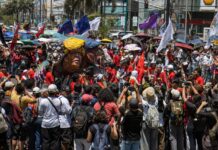
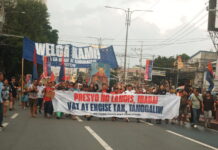
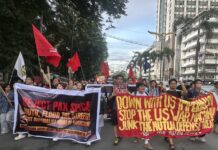
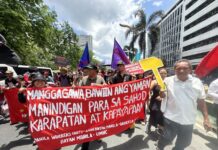




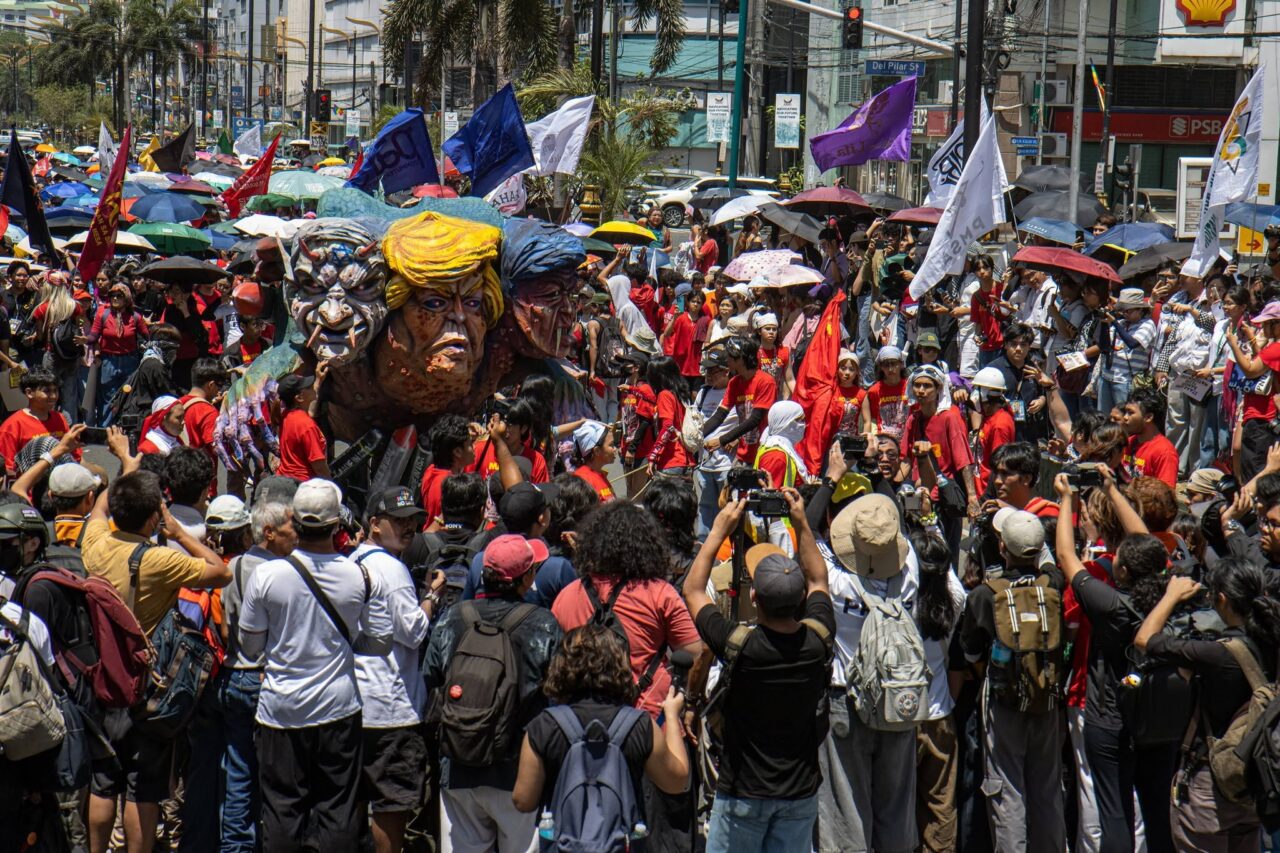
“Homes are destroyed, livelihoods are lost, nations are lost by interests that are made far beyond our own borders. Even now, initiatives like Pax Silica, supply chains for critical minerals and semiconductors are being reordered around the needs of the US war machine, and countries like us [the Philippines] are being asked to serve as suppliers and now become their targets, rather than being allowed to decide our own development,” said Dr. Giovanni Tapang, convener of the Stop the US-Israel War on Iran Network.
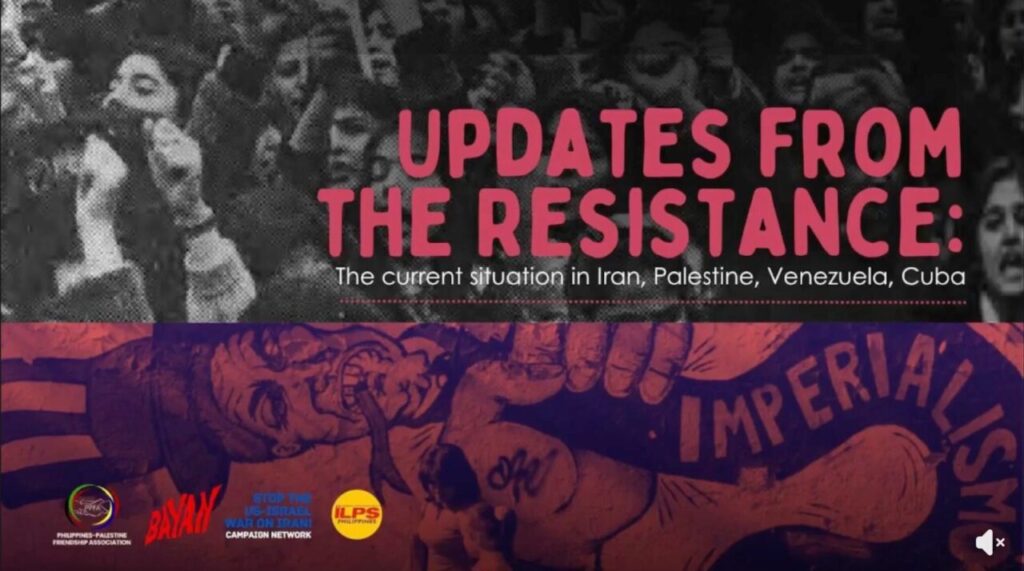
Various anti-imperialist groups gathered for the webinar Updates from the Resistance: The Current Situation in Iran, Palestine, Venezuela, and Cuba, co-organized by BAYAN, the International League of Peoples’ Struggle (ILPS) Philippines, the Philippines-Palestine Friendship Association (PPFA), and the Stop the US-Israel War on Iran Campaign Network, to express people’s solidarity in lambasting US imperialism following its sanctions, blockades, military aggression, and other forms of intervention and coercion against the people.
“This is the war machine that we are fighting against. And as we listen to those who are on the front lines, we learn of their resistance, deepen our understanding, and together strengthen solidarity to defeat this war machine,” Tapang added.
Power of the people
“We have seen the case of Venezuela: how this warfare has been attacking the Global South, attacking the country, and in many, many aspects, not only the political one, military, economic, and cultural, and in social consciousness. Venezuela is under siege now,” said Richard Lobo, Venezuela’s Chargé d’Affaires.
Venezuela possesses the world’s largest proven crude oil reserves, estimated at around 303 billion barrels as of 2023, according to the US Energy Information Administration.
Lobo noted that US intervention in Venezuela extends beyond economic sanctions to political, military, economic, and cultural intervention.
In January 2026, the US launched Operation Absolute Resolve as a large-scale military operation in Venezuela framed around drug trafficking and national security that led to the capture of President Nicolás Maduro and First Lady Cilia Flores and their transfer to the United States. Such an operation also targeted Venezuelan military infrastructure across Caracas and other locations.
Months after Maduro’s capture, the US laid out an agreement to gain access and control over an estimated 65 billion barrels of oil reserves, mineral wealth, and other resources.
Meanwhile, Lobo emphasized that the situation has only amplified the resistance among Venezuelans in defending their sovereignty and their right to determine the country’s political and economic direction.
“Even though we have been under attack […] the people there in Venezuela have been resisting and have been struggling. And one thing that I can say right now is that even with the kidnapping of our president, they believe the government is still in power,” Lobo stated.
Fighting the Epstein class
More than 5,000 civilians have been killed in the US-Israel aggression against Iran, including 168 girls who were killed when a school was struck in March this year.
“Iran is experiencing aggression by the United States and Israel since the 1979 revolution against a very corrupt government, the Shah’s government. The United States has been trying to overthrow the revolutionary government in Iran, engaging in economic warfare for 46 years,” said Dr. Foad Izadi, associate professor at the University of Tehran.
The 1979 Iranian Revolution overthrew Shah Mohammad Reza Pahlavi, whose government had maintained close relations with the US. The revolution fundamentally changed Iran’s relationship with the US, posing decades of diplomatic confrontation, economic sanctions, and political pressure.
“(The US) has also asked Iran to reduce its support for the Palestinian cause. As you know, Iran has been a strong supporter of Palestine. Not only with words, not only with speeches, but with military aid. Iran is the only country that is helping Palestinians with military aid,” said Dr. Izadi, noting that other governments should also learn from them by providing help to those countries fighting against aggression and genocide.
“Iran has learned that if you allow Israelis, genocidal people, the apartheid regime to get away with their crimes in Palestine, they they would want to take over the Middle East and go beyond,” he added.
Meanwhile, similar to Venezuela, Dr. Izadi noted that the US-Israel are targeting Iran not only because of its continued support for Palestine but also because of its strategic importance including its large oil and gas reserves.
Iran is one of the world’s major oil and gas producers. The Strait of Hormuz, through which a significant share of global oil shipments passes, makes Iran strategically important to international energy markets.
“Although the war is hurting Iranians, it’s also hurting people in the Philippines and basically all over the world because of this illegal aggression on Iran. Oil supplies have been disrupted, and that is affecting everybody all around the globe with higher gas prices,” said Dr. Izadi.
Dr, Izadi further observed the US-Israel aggression and colonial expansion in West Asia, pointing to the idea of “Greater Israel,” which encompasses territories in Saudi Arabia, Egypt, Jordan, Syria, Iraq, and Lebanon.
He argued that Israel’s territorial expansion should be understood as an attempt to reproduce colonial practices in the present period.
“They have talked about Greater Israel, which includes Saudi territory, Egyptian territory, Jordanian territory, Syrian territory, Iraqi territory, Lebanese territory, and they have already taken over Syria and Lebanese territory,” Dr. Izadi said, calling it the “19th-century colonialism in the 21st century.”
Following the US-Israel aggression, Dr. Izadi said Iran has developed indigenous technology, including ballistic missiles and drones in response to the attacks.
“Iran has used indigenous technology to build quite sophisticated ballistic missiles and drones to hit the aggressor regimes, US-Israel,” Dr. Izadi noted, describing Iran’s ability as a non-nuclear state to resist attacks from two nuclear-armed states.
He also warned that if the US gains control over regional resources, it could use them as leverage against countries like the Philippines, among others.
“We are fighting the Epstein class. The Epstein class that likes to rape little American girls and kill little Iranian girls,” he added.
Cuba as ‘Silent Gaza’
“This is a very crucial moment for our civilization,” said Republic of Cuba ambassador Yadira Ledesma Hernández, describing the worsening conditions faced by Cubans under decades of US comprehensive economic, commercial, and financial restrictions.
“The US has threatened many enterprises across the world not to sell oil to us, even the enterprises in the business of cargo and shipments. We have many containers in the islands of the Caribbean with medicines and with food, but they threaten those companies: if you bring containers of food and medicine to Cuba, we will seize your bank account,” the ambassador shared.
For more than six decades, the US maintained its restrictions and embargo against Cuba beginning after the 1959 Cuban Revolution and the subsequent nationalization of properties and realignment of Cuba’s political and economic relations. This year, the US sanctions further intensified by imposing an oil and energy blockade.
Cuba’s electricity crisis has also triggered a water crisis as prolonged blackouts disrupted water distribution across the country. Around 3.5 million people across Cuba are affected, including hospitals and clinics struggling for basic sanitation and healthcare services.
“Imagine the families are facing more than one day without electricity. We don’t have electricity. You cannot have water. And without water you cannot live,” she added.
Since the 1959 Cuban Revolution, healthcare has become one of its major social programs by transforming it into a publicly funded and universal model for free access, preventive medicine, primary healthcare, vaccination, and maternal and child health.
Meanwhile, Cuba’s infant mortality rate rose from 4.0 deaths per 1,000 live births in 2018 to 7.2 in 2022.
“The human damage, we cannot say how much it is, because it’s already claiming lives in our country that used to have an excellent healthcare system that we provide for free. Nowadays, our infant mortality rate has doubled,” Ledesma shared, describing the situation in Cuba as a “silent Gaza” following the humanitarian consequences of restrictions marred by destruction and deprivation endured by Palestinians.
Looking beyond statistics
“Palestine is not something I learned from textbooks. It is the place where I was raised, the place of my family, my memories, my education and my community. We are not speaking about an abstract geopolitical conflict. We are speaking about millions of human beings whose lives, homes, families, and futures have been shaped by decades of displacement, occupation, blockade, and war. The situation in Palestine must be understood within this longer historical context,” said Mahadia Abu-Dalal, a Palestinian peace advocate and educator.
Since October 2023, the scale of destruction in Gaza has been devastating. More than 74,000 Palestinians have been killed and over 175,000 injured, according to Gaza’s Health Ministry.
Despite the ceasefire announced in October 2025, the humanitarian crisis has continued and worsened. As of October 1, at least 1,439 Palestinians had been killed and 5,052 injured in Gaza since the ceasefire began.
Nearly two million remain displaced, scrambling for shelter in overcrowded displacement sites or damaged buildings. Access to food, clean water, medicine, and other necessities has been severely restricted.
The healthcare system also remains under extreme strain, with only 19 out of 36 hospitals in Gaza partially functioning, and essential medical supplies and equipment fall critically short. The World Health Organization also said that approved aid can currently enter Gaza only through Kerem Shalom, while other crossings remain closed.
The United Nations also reported the heightened risk of waterborne diseases among displaced communities as water and sanitation remain major concerns. Around 77% of households depend on water trucking, while all six wastewater treatment plants are non-functional and around 70 percent of sewage pumping stations are inoperable.
The peace advocate urged the people to look beyond the statistics and remember the lives and identity behind them. For Abu-Dalal, this is where solidarity must move beyond sympathy.
She further called on institutions and governments to uphold international humanitarian law, human rights, self-determination and equality.
“You cannot ask the victims to live in peace when there is no justice, because peace requires justice,” Abu-Dalal said. “It requires safety, freedom, dignity, accountability, and it requires that Palestinian lives be valued equally with every other human life.”
The way forward
“We need to explain and condemn what those imperialist powers are doing,” Ledesma implored.
For her, there is a need for progressive forces around the world to continue articulating and amplifying people’s resistance against what she referred to as “new neocolonialism strategies”.
“We have businessmen that control the media. And and social media in particular, and for us, this is something really that we need to take into account from the less to try to share our views and articulate because we will not have the capacity. To put in the news what they put. But definitely we need to share our experience,” she added.
Speakers also shared that the culture of resistance is shaped by forms of democratic expression as communities come together to rally and express solidarity in support of people’s struggle in Iran, Cuba, Venezuela, and Palestine.
“People come out of their house. They go to the square near the house; they see their neighbors, and generally their speeches, messages of solidarity, patriotic songs, people waving flags and shouting against Netanyahu and Trump for all the crimes that the country Iran has suffered,” Dr. Izadi said.
“The current situation is tough, but people are resisting, and Iran’s military has been able to defend the country in a very, very serious manner,” he added.
As an artist and educator, Abu-Dalal witnessed how creativity can become a form of survival. She said that resistance takes many forms through documenting violations, teaching children, preserving language, writing poems, creating art, or simply planting an olive tree.
“This is also a struggle over memory and identity,” she said, “When a home is destroyed. What disappears is not simply concrete or stone. It is family photographs, the embroidery, the books, the memories, the olive trees, the kitchen where generations gathered, and the stories that connect one generation to another.”
“Peace is not simply the absence of bombs. It’s not the absence of war or bombs or killing. A population cannot be expected to live under permanent domination and be told that this is peace. You do not have to be Palestinian to care about Palestine. You do not have to share our history to recognize injustice. And you do not have to speak Arabic to say that every child deserves a future. Your solidarity matters. Your voice matters. Your classrooms matter. Your art and your institutions matter, and your choices as citizens matter,” she concluded.


